


Psychosocial Hazards in Mining and Resources: WHS Obligations and FIFO Documentation
Suicide is the leading cause of death for working-age Australians, and the mining and resources sector is among the hardest hit, a pattern WA's own "Enough is Enough" inquiry into FIFO mental health put on the public record. Regulatory scrutiny of FIFO and camp-based work has intensified since, including a dedicated WA code of practice for mentally healthy FIFO workplaces. This page covers what the WHS obligation actually requires, the hazards most relevant to mining and resources, and what a realistic first response looks like.
What the law requires
Under the model Work Health and Safety Act, mining and resources operators (as PCBUs) must identify psychosocial hazards, assess the risk, implement controls, and review their effectiveness, the same process used for physical and mining-specific hazards. In Western Australia specifically, a dedicated code of practice covers mentally healthy workplaces for FIFO workers in the resources and construction sectors, and a further code covering accommodation facility design is in development. This page addresses the general WHS psychosocial duty; state mining safety legislation and FIFO-specific codes sit alongside it, not instead of it.
What regulators look for is evidence that the process occurred: records of hazard identification, consultation with workers (including FIFO and camp-based crews, not only site management), control decisions, and review. A wellbeing app or an EAP number on a poster is not evidence of that process.
The 6 most common hazards in mining and resources
Here are the six hazards most relevant to mining and resources, each with a realistic first control and what to record. You do not need all six solved to be compliant. You need evidence that you are working through them.
FIFO and DIDO isolation from family and community
Extended separation from family, partners and community support networks during a swing is one of the most consistently identified psychosocial hazards in FIFO and DIDO arrangements, and is named explicitly in WA's mentally healthy FIFO workplaces code of practice. A first control is guaranteed, reliable communication access (phone or internet) built into the roster, not left to site infrastructure. Record: that communication access was assessed for this site or camp, what was found, and what was done about any gaps.
Camp culture and accommodation conditions
Poor accommodation standards, shared facilities, and a camp culture that normalises harassment or exclusion are recognised hazards distinct from the work itself, and are the subject of a dedicated code of practice currently in development. A first control is a documented accommodation standard with a clear channel for raising concerns that does not go through the immediate supervisor. Record: that the standard exists, when accommodation was last assessed against it, and how concerns raised were resolved.
Extreme fatigue from swing rosters
Twelve-hour shifts, back-to-back swings and travel time either side of a roster compound fatigue in ways that a standard fatigue management plan does not always capture. A first control is a documented fatigue risk assessment specific to the roster pattern in use, reviewed when the pattern changes. Record: when the assessment was last done, what roster it covers, and what fatigue controls (rest breaks, travel buffers) are in place.
Remote and isolated work with limited support access
Working at a remote site or in a role with no immediate peer support (a lone operator, a night-shift controller) removes the informal safety net that catches early warning signs elsewhere. A first control is a named, reachable check-in contact for isolated roles, with a defined check-in frequency. Record: who the contact is, how often check-ins occur, and any missed check-ins with what follow-up happened.
High-consequence decision-making under time pressure
Operators and supervisors making safety-critical calls under production pressure, whether to stop a line, flag equipment, or delay a shift, carry a distinct psychosocial load tied to the consequence of getting it wrong. A first control is a documented stop-work authority that is genuinely exercised, not just written down. Record: instances where stop-work authority was used, and what happened as a result, so the control can be shown to actually function.
Poor organisational change management and job insecurity
Commodity price cycles, restructures, and the introduction of automation and AI-assisted systems (predictive maintenance, autonomous haulage) are recurring sources of job insecurity anxiety in the sector, whether or not headcount actually changes. A first control is transparent communication of what a change will and will not affect, delivered before rumour fills the gap. Record: that the communication occurred, what was said, and what questions were raised and answered.
Check Your Compliance
A short set of questions on how hazards get identified, documented and reviewed today, scored against your state's Code, with a gap analysis you can act on.
The simplest form of compliance is a documented conversation
A supervisor who notices a FIFO worker seems withdrawn partway through a swing does not need a platform, a survey, or a formal incident report to begin a compliant response. They need to have a conversation and write it down.
What that looks like in practice:
That is a psychosocial consultation. It identifies a hazard, surfaces worker input, and documents a control action. It does not require a formal process to begin. It requires a habit of writing it down.
As that habit grows, covering more workers, more issues, and more consistent records, the organisation builds the evidentiary record that regulators and insurers ask for when something goes wrong.
Whichever hazard the record starts from, this is what it looks like once it has been tracked through to a closed loop:
What this looks like when it's running
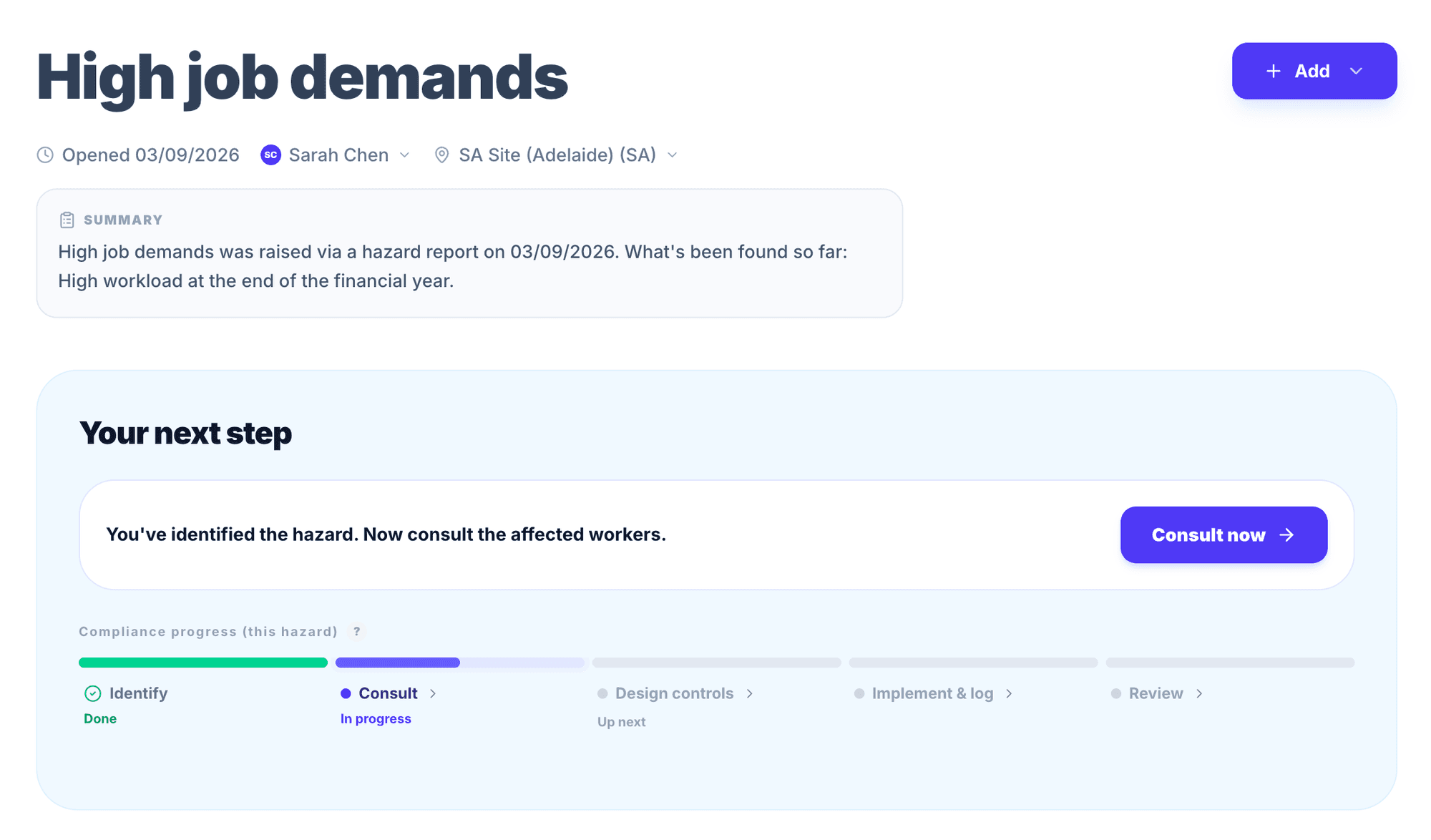
Doing this by hand works until it doesn't. Across every hazard, every worker, and every review date, the record gets hard to hold in your head. That is what PsychProof runs. It takes the same four steps, identify, consult, control, review, and keeps them as one time-stamped trail per hazard: the evidence regulators and insurers ask for when something goes wrong. Here is one hazard tracked end to end.
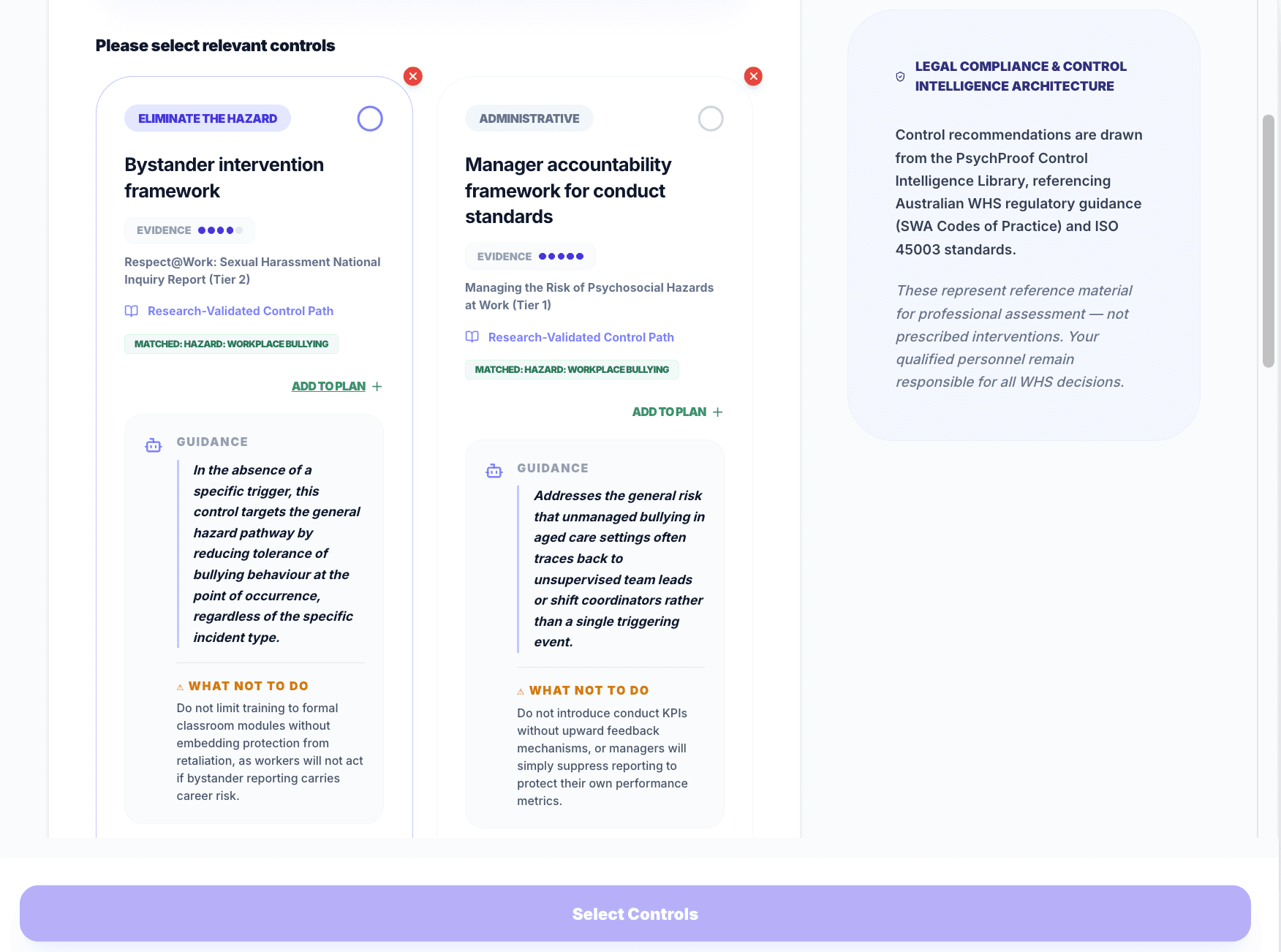
Controls aren't just chosen. They're categorised against the hierarchy, engineering and systemic before administrative, and the categorisation is part of the record.
Try our pilot programme
Pick a department, a unit, or a small team. We run PsychProof there on real hazards for six months, so you can see if it's for you, with nothing committed beyond that one team.
What to read next
Planning a restructure, AI rollout, or new system?
Change is a named psychosocial hazard in its own right. See how PsychProof assesses a change before it happens, not just the hazards it leaves behind.
Get the printable PsychProof overview
A working note on where PsychProof fits, what it does and does not do, and how the methodology adapts to your sector. Print it or send it internally.
Important Notice
This information is general in nature and provided for awareness and documentation support only. It does not constitute legal, clinical, or professional advice. Regulatory obligations vary by jurisdiction and circumstances. Organisations should refer to relevant regulators or qualified professionals for advice specific to their situation.