



Psychosocial Hazards in Queensland: WHS Obligations for QLD Employers
Queensland employers have a legally enforceable duty to manage psychosocial hazards in the workplace. The Work Health and Safety Act 2011 (Qld) imposes a primary duty of care on persons conducting a business or undertaking (PCBUs) to eliminate or minimise psychosocial risks so far as is reasonably practicable. The Managing the Risk of Psychosocial Hazards at Work Code of Practice 2022 (Qld) provides the practical framework for meeting this duty, and sets the standard against which Workplace Health and Safety Queensland (WHSQ) inspectors assess compliance.
Employer Expectations in QLD
The 2022 Code of Practice sets out four specific obligations for PCBUs in Queensland:
- Identify psychosocial hazards: through worker consultation, observation, workplace inspections, and review of available data including incident reports and workers' compensation claims.
- Assess the risks: considering the likelihood and severity of harm, the breadth of exposure, and any existing controls.
- Implement controls: using the hierarchy of risk control, prioritising elimination and substitution before administrative measures.
- Review controls: on a scheduled basis and whenever a significant change occurs, to verify effectiveness and identify emerging hazards.
The Code also specifies that worker consultation is not optional: it is a mandatory part of each step. PCBUs must give workers a genuine opportunity to contribute to hazard identification and control design.
Queensland's Psychosocial Hazard Framework
Queensland adopted the national harmonised WHS framework in 2011. The Work Health and Safety Act 2011 (Qld) mirrors the model WHS Act, with the primary duty of care under Section 19 requiring PCBUs to ensure the health, including psychological health, of workers so far as is reasonably practicable.
The Managing the Risk of Psychosocial Hazards at Work Code of Practice 2022 is approved under Section 274 of the WHS Act. Compliance with an approved Code of Practice is not mandatory, but a PCBU that does not follow it must demonstrate an equivalent or better standard of protection. In practice, the Code defines the floor of acceptable conduct for WorkSafe Queensland.
The Code specifies a four-step risk management process: identify psychosocial hazards, assess the risks they create, implement control measures, and review the effectiveness of those controls over time. Each step is expected to be documented and to involve genuine worker consultation.
Common Psychosocial Hazards in Queensland Workplaces
Safe Work Australia identifies the following common psychosocial hazards applicable to Queensland workplaces across all sectors. High-risk industries in Queensland, including mining, healthcare, aged care, construction, and transport, face elevated exposure to many of these hazards given their work design and operating conditions.
| # | Hazard (exact SWA term) | Why it matters in QLD |
|---|---|---|
| 1 | Job demands | High-demand sectors including mining, healthcare, and aged care are among Queensland's largest employers |
| 2 | Low job control | Prevalent in FIFO/DIDO operations, aged care rostering, and construction subcontracting |
| 3 | Poor support | Particularly acute for workers in remote QLD operations or rural healthcare facilities |
| 4 | Lack of role clarity | Common in Queensland's large construction and infrastructure project sector |
| 5 | Poor organisational change management | Relevant to QLD's resource sector volatility and ongoing aged care sector reform |
| 6 | Inadequate reward and recognition | Documented in QLD's public sector and health service workforce surveys |
| 7 | Poor organisational justice | Raised in parliamentary inquiries into QLD mining and resources sector culture |
| 8 | Traumatic events or material | Occupational exposure in QLD emergency services, healthcare, and mining |
| 9 | Remote or isolated work | Significant in QLD given the geographic scale of FIFO operations and remote communities |
| 10 | Poor physical environment | Heat stress and environmental conditions compound psychosocial risk in QLD outdoor industries |
| 11 | Violence and aggression | Documented in QLD hospitals, aged care, and public-facing roles across government services |
| 12 | Bullying | The subject of sustained WorkSafe Queensland enforcement focus and inspector guidance |
| 13 | Harassment, including sexual and gender-based harassment | QLD resources sector inquiry findings have driven heightened regulatory attention |
| 14 | Conflict or poor workplace relationships and interactions | Elevated in project-based construction environments with transient workforces |
Sector-Specific Guidance for Queensland
Psychosocial risk exposure varies significantly by sector. If you operate in one of Queensland's higher-risk industries, these resources apply the same regulatory framework to your specific operating context:
Check Your Compliance
A short set of questions on how hazards get identified, documented and reviewed today, scored against the Queensland Code, with a gap analysis you can act on.
Where PsychProof sits in a QLD employer's toolkit
Survey tools stop at identification. Incident systems start after harm. PsychProof owns the step in between, the one WHSQ actually enforces on.
A PAW or COPSOQ survey tells you where the hazards are. A workers' compensation claim or incident report tells you harm has already occurred. Neither produces the thing WHSQ inspectors ask for during a proactive audit or a notifiable incident response: a dated, ongoing record showing hazards were identified, controls were designed against the hierarchy, workers were consulted, and effectiveness was reviewed before anything went wrong.
That is the gap most Queensland employers have. Not a lack of survey data, and not a lack of an EAP provider, but a lack of the connective evidence between the two. PsychProof is built specifically for that step.
WHSQ Enforcement and Psychosocial Risk
Workplace Health and Safety Queensland (WHSQ), part of the Office of Industrial Relations, is the primary WHS regulator in Queensland. Inspectors have authority to enter workplaces, require documentation, and issue improvement notices or prohibition notices where psychosocial risk management is inadequate.
Enforcement activity around psychosocial hazards has increased since the 2022 Code of Practice came into force. WHSQ has signalled that it will assess whether organisations can demonstrate a genuine, ongoing risk management cycle, not just the existence of a policy or an EAP provider.
In the resources sector, the Resources Safety and Health Queensland (RSHQ) regulator operates in parallel, with specific obligations for mine operators under the Safety in Mines Testing and Research Station (SIMTARS) framework and relevant mining legislation.
Organisations that cannot produce a documented, time-stamped record of hazard identification, risk assessment, control implementation, worker consultation, and review cycles are at material risk of enforcement action, particularly where a psychological injury claim has occurred.
What the Documentation Gap Looks Like in Queensland
Most Queensland employers have some form of incident reporting and an EAP provider. Fewer have a structured record of proactive psychosocial hazard management: the kind of ongoing documentation that demonstrates the four-step cycle was operating before a harm event occurred.
When a workers' compensation claim, psychological injury allegation, or WorkSafe Queensland inspection arises, the organisation needs to be able to produce:
- Evidence that specific psychosocial hazards were identified at the relevant workplace
- A record of what risk controls were implemented and when
- Documentation that control effectiveness was reviewed
- Worker consultation records tied to specific hazards or site conditions
Gaps in any of these areas, even where genuine management action occurred, leave the organisation without the evidence needed to demonstrate its duty of care was met under the WHS Act 2011 (Qld).
Legislative framework
How this differs from other jurisdictions
Queensland was an early mover on formal psychosocial hazard duties, and the rest of the country has largely followed: Victoria's Psychological Health Regulations commenced December 2025 and South Australia's Code of Practice took effect February 2026, so the hierarchy-of-controls requirement is now common across most jurisdictions, not unique to QLD. What genuinely sets Queensland apart is the mandatory written prevention plan for sexual and gender-based harassment under s.55H, a duty most other states do not impose. See our Australian comparison page for more details.
What inspectors look for in Queensland
Workplace Health and Safety Queensland (WHSQ), through its Psychological Health Unit, conducts targeted enforcement and site inspections. Inspectors look for demonstrable risk management aligned with the hierarchy of controls and specific documentation of hazard mitigations.
Jurisdiction-specific obligations
Written prevention plan (s.55H, inserted by the Work Health and Safety (Sexual Harassment) Amendment Regulation 2024 (Qld)): Mandatory from 1 March 2025, PCBUs must maintain a written prevention plan for sexual harassment and sex/gender-based harassment, prepared in consultation with workers. Additionally, in mining, the separate regulator Resources Safety and Health Queensland (RSHQ) enforces these rules.
How PsychProof maps to Queensland obligations
PsychProof's evidence trail directly cites the Work Health and Safety Regulation 2011 (Qld) and the Managing the Risk of Psychosocial Hazards at Work Code of Practice 2022 (Qld). A PsychProof export demonstrates to WHSQ inspectors that the hierarchy of controls is being applied in practice.
See what running this looks like for a Queensland employer
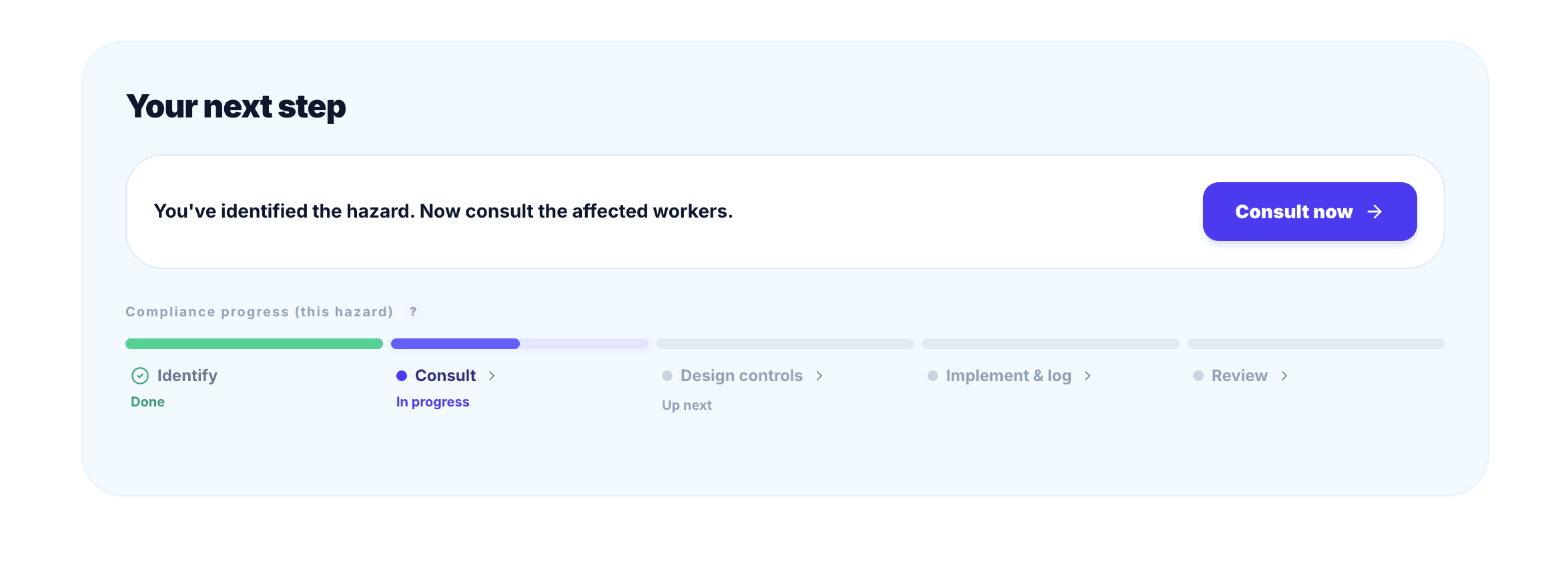
PsychProof runs the QLD Code's four-step cycle for every hazard and closes it with a dated review, the evidence trail WHSQ asks for.
What to read next
What does "psychosocial" actually mean?
The plain-English definition behind the Act and Code language on this page, and why the distinction from mental health and HR matters operationally.
A worked risk assessment example
See the identify-assess-control-review cycle applied to a real hazard, from first identification through to a closed, reviewed control.
Important Notice
This information is general in nature and provided for awareness and documentation support only. It does not constitute legal, clinical, or professional advice. Regulatory obligations vary by jurisdiction and circumstances. Organisations should refer to relevant regulators or qualified professionals for advice specific to their situation.