

Managing Psychosocial Hazards in Western Australia: Compliance Guide
In Western Australia, psychosocial hazard obligations are governed by the Work Health and Safety Act 2020 (WA) and WA's own Code of Practice: Psychosocial Hazards in the Workplace 2022, a separate instrument from the SWA model code used in most other states. The hierarchy of controls is not a legal requirement for psychosocial risks in WA, though it remains best practice. The mining sector carries additional obligations under the Work Health and Safety (Mines) Regulations 2022, with dedicated Wellbeing Inspectors of Mines conducting targeted psychosocial site inspections.
Legislative framework
WA runs its own suite of instruments rather than the Safe Work Australia model code used in most other states. The instruments below apply together, with the mining-specific regulation sitting alongside the general WHS framework for mine sites.
Sector-Specific Guidance for Western Australia
Psychosocial risk exposure varies significantly by sector. If you operate in one of Western Australia's higher-risk industries, these resources apply the same regulatory framework to your specific operating context:
Check Your Compliance
A short set of questions on how hazards get identified, documented and reviewed today, scored against WA's Code, with a gap analysis you can act on.
Where PsychProof sits in a WA employer's toolkit
Survey tools stop at identification. Incident systems start after harm. PsychProof owns the step in between, the one WorkSafe WA actually looks for on site.
Because WA does not make the hierarchy of controls a strict legal requirement, it is treated by many employers as optional paperwork rather than the standard WorkSafe WA inspectors and Wellbeing Inspectors of Mines actually apply in practice. A PAW or COPSOQ survey tells you where the hazards are. A workers' compensation claim tells you harm has already occurred. Neither produces the ongoing, dated record of identification, control design, worker consultation, and review that demonstrates best-practice management under WA's own Code.
That is the gap most WA employers have, whether general industry or FIFO mining operations. PsychProof is built specifically for that connective step.
What inspectors look for in Western Australia
WorkSafe WA (WorkSafe Commissioner) oversees general industries. For mining, WorkSafe Mines Safety and Wellbeing Inspectors of Mines specifically target camp culture, isolation, and fatigue controls, and enforce the hierarchy of controls in practice.
How this differs from other jurisdictions
Unlike the model code states, WA uses its own suite of codes. The hierarchy of controls is explicitly excluded from being a mandatory legal requirement, though it is strongly recommended best practice. Find out more on our comparison page.
Jurisdiction-specific obligations
WA integrates several overlapping codes of practice. Mining operations are separately regulated by WorkSafe Mines Safety, and FIFO operations must consider specific codes relating to camp culture and isolation.
How PsychProof maps to Western Australia obligations
PsychProof cites the WA specific Code of Practice 2022 and WHS (General) Regulations 2022. It captures the comprehensive consultation and risk mitigation strategies expected by WorkSafe WA.
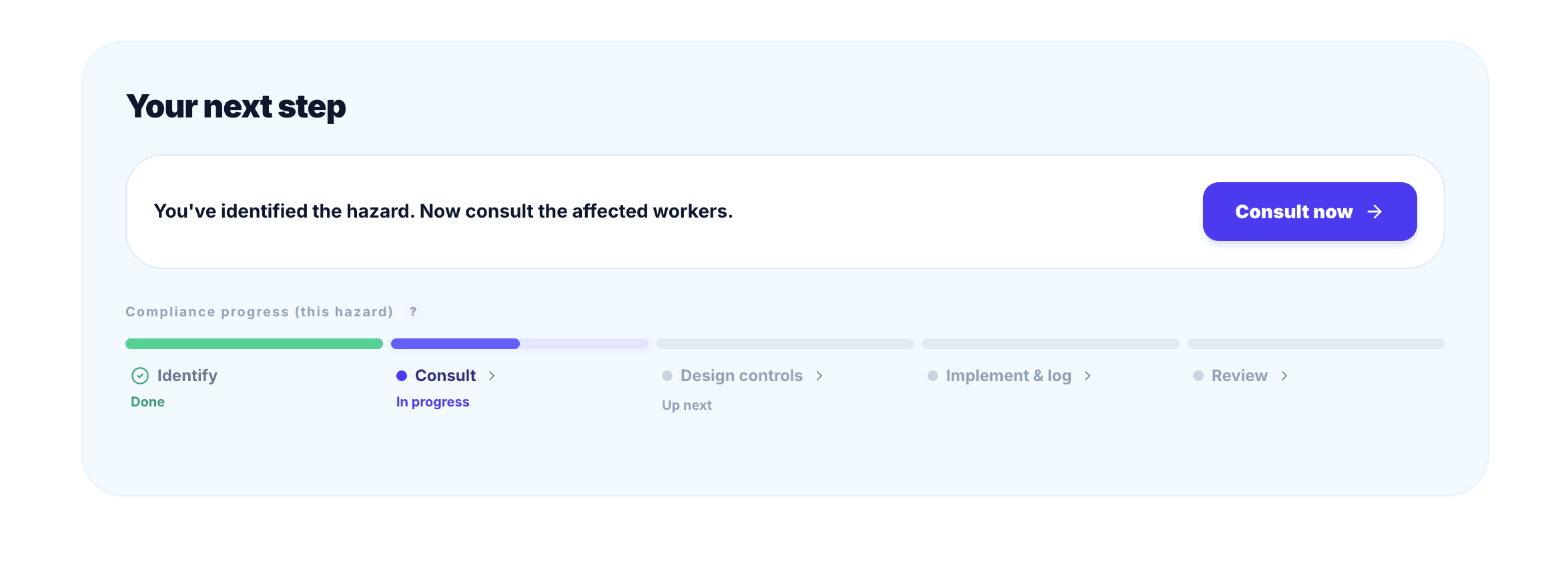
See what running this looks like for a WA employer
PsychProof runs the identify-consult-control-review cycle for every hazard and closes it with a dated review, the evidence trail WorkSafe WA looks for.
What to read next
What does "psychosocial" actually mean?
The plain-English definition behind the Act and Code language on this page, and why the distinction from mental health and HR matters operationally.
A worked risk assessment example
See the identify-assess-control-review cycle applied to a real hazard, from first identification through to a closed, reviewed control.
Important Notice
This information is general in nature and provided for awareness and documentation support only. It does not constitute legal, clinical, or professional advice. Regulatory obligations vary by jurisdiction and circumstances. Organisations should refer to relevant regulators or qualified professionals for advice specific to their situation.