


Psychosocial Hazards in Construction and Trades: WHS Obligations and Where to Start
Australian construction workers are around six times more likely to die by suicide than from a workplace accident, a pattern serious enough that the industry built its own suicide prevention program, MATES in Construction, after research found youth suicide rates in commercial construction well above the general population. The WHS obligation to manage psychosocial hazards applies on every site, project-based or permanent. This page covers what you are required to do, the hazards most relevant to construction and trades, and what a realistic first response looks like.
What the law requires
Under the model Work Health and Safety Act, builders, principal contractors and subcontractors (as PCBUs) must identify psychosocial hazards, assess the risk, implement controls, and review their effectiveness, the same process used for physical site hazards. The Safe Work Australia model Code of Practice on Managing Psychosocial Hazards at Work applies regardless of project size or how many tiers of subcontracting sit between the worker and the head contract.
What regulators look for is evidence that the process occurred: records of hazard identification, consultation with the workforce actually on site (including subcontracted trades, not only direct employees), control decisions, and review. Industry programs such as MATES in Construction provide valuable peer support and suicide prevention training, but they are not a substitute for the documented WHS risk management process a regulator will ask to see.
The 6 most common hazards in construction and trades
Here are the six hazards most relevant to construction and trades, each with a realistic first control and what to record. You do not need all six solved to be compliant. You need evidence that you are working through them.
Job insecurity from project-based and casualised employment
Uncertainty between projects, and the reality that a trade's next job depends on being picked up again, is a structural psychosocial hazard distinct from any specific project's risks. A first control is transparent, early communication about upcoming work and project timelines wherever the business genuinely has visibility of them. Record: what was communicated, when, and to which crews.
High job demands under deadline and weather pressure
Compressed programs, liquidated damages clauses and weather-driven catch-up work push demand well above what a crew can sustainably absorb. A first control is a documented process for escalating when a program is genuinely unachievable, rather than absorbing the pressure silently. Record: when the process was used, what was raised, and what changed.
Remote and isolated site work
Regional and remote projects, including FIFO-style arrangements in construction and resources-adjacent work, carry the same isolation risk documented in mining: distance from family, limited communication access, and reduced peer support. A first control is guaranteed communication access built into the site arrangement. Record: that access was assessed for this site, and what was done about any gaps.
Bullying, harassment and poor organisational justice on site
Site culture, hierarchical trade relationships, and a workforce that moves between employers frequently can normalise behaviour that would not be tolerated in a fixed workplace. A first control is a reporting pathway that works across the subcontracting chain, not just within one employer. Record: that the pathway exists, that inductions cover it, and how any reports were handled.
Traumatic events and exposure to serious incidents
Construction has a materially higher rate of serious injury than most industries, and workers on a site where a serious incident occurs, whether or not they were directly involved, carry a real psychosocial exposure. A first control is a structured post-incident response that includes affected workers beyond just the person injured. Record: who was offered support, what was offered, and whether it was taken up.
Poor change management through subcontracting chains
Frequent changes of foreman, crew composition, and head contractor personnel make consistent communication about site changes genuinely difficult, and workers absorb that inconsistency as uncertainty. A first control is a simple, repeatable induction-style briefing whenever site leadership or major scope changes. Record: that the briefing occurred, when, and who attended.
Check Your Compliance
A short set of questions on how hazards get identified, documented and reviewed today, scored against your state's Code, with a gap analysis you can act on.
The simplest form of compliance is a documented conversation
A site supervisor who notices a tradesperson seems off, or picks up on a comment about money trouble or a relationship breakdown, does not need a platform, a survey, or a formal incident report to begin a compliant response. They need to have a conversation and write it down.
What that looks like in practice:
That is a psychosocial consultation. It identifies a hazard, surfaces worker input, and documents a control action. It does not require a formal process to begin. It requires a habit of writing it down.
As that habit grows, covering more workers, more issues, and more consistent records, the organisation builds the evidentiary record that regulators and insurers ask for when something goes wrong.
Whichever hazard the record starts from, this is what it looks like once it has been tracked through to a closed loop:
What this looks like when it's running
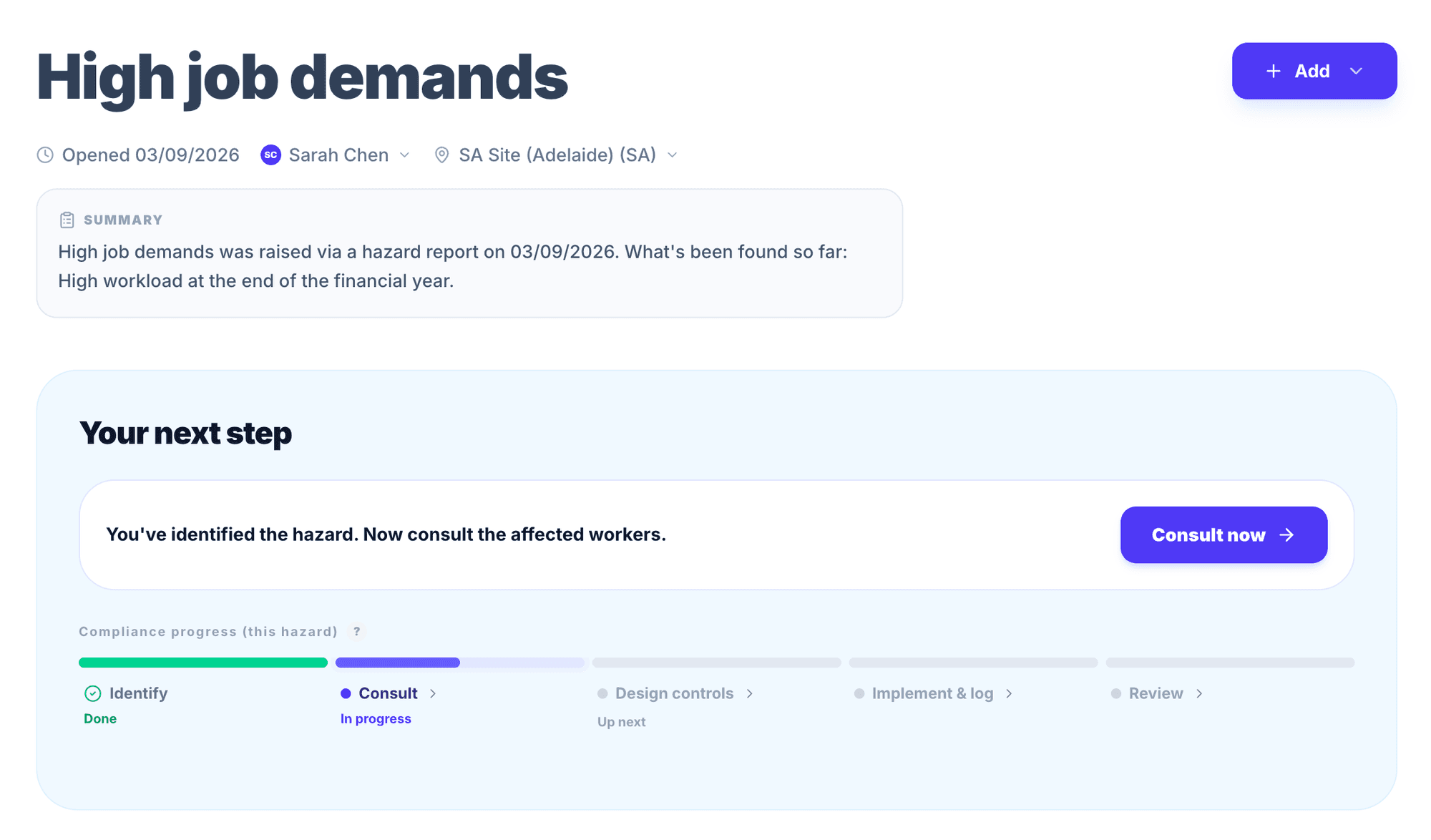
Doing this by hand works until it doesn't. Across every hazard, every worker, and every review date, the record gets hard to hold in your head. That is what PsychProof runs. It takes the same four steps, identify, consult, control, review, and keeps them as one time-stamped trail per hazard: the evidence regulators and insurers ask for when something goes wrong. Here is one hazard tracked end to end.
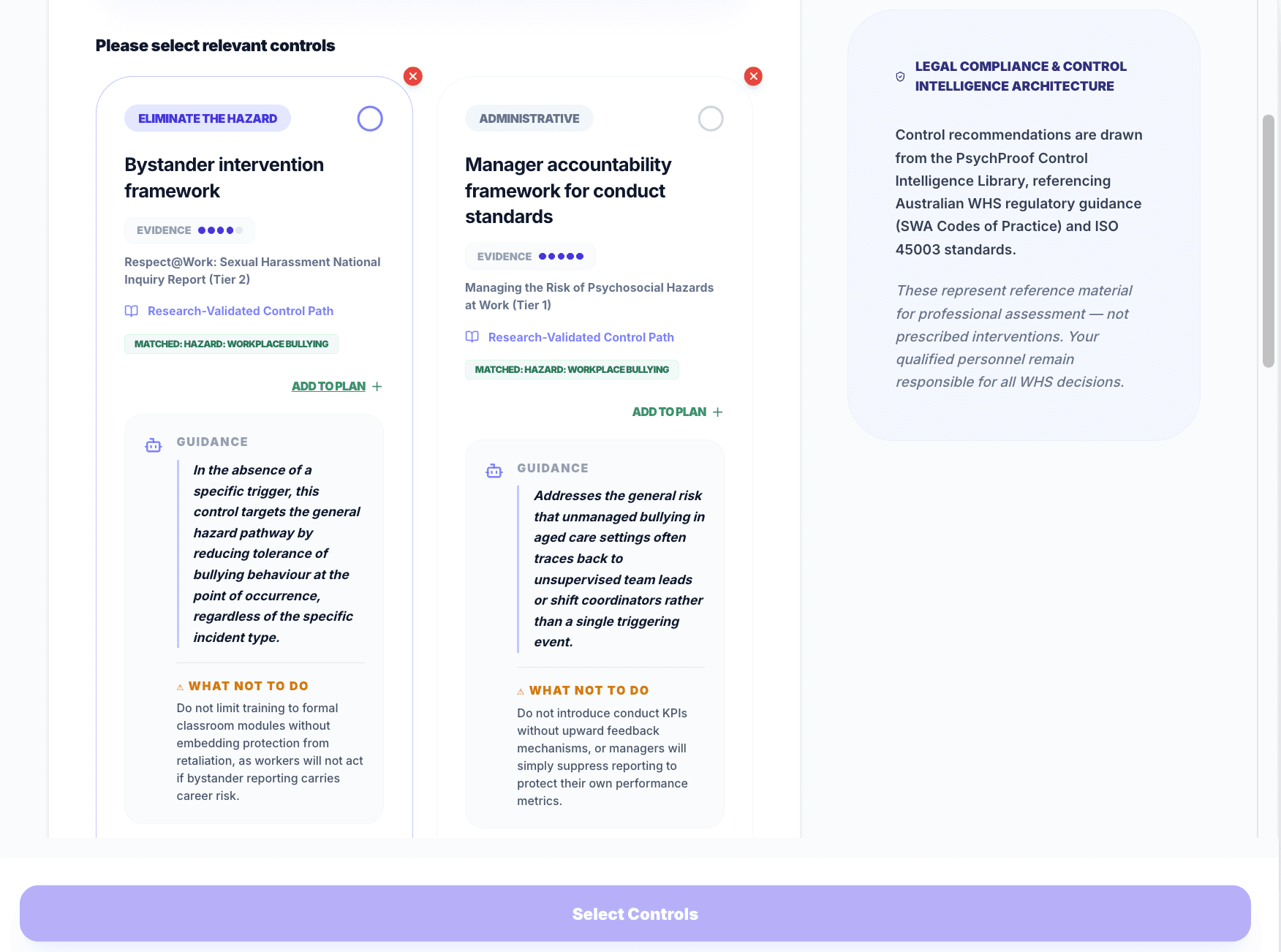
Controls aren't just chosen. They're categorised against the hierarchy, engineering and systemic before administrative, and the categorisation is part of the record.
Try our pilot programme
Pick a department, a unit, or a small team. We run PsychProof there on real hazards for six months, so you can see if it's for you, with nothing committed beyond that one team.
What to read next
Planning a restructure, AI rollout, or new system?
Change is a named psychosocial hazard in its own right. See how PsychProof assesses a change before it happens, not just the hazards it leaves behind.
Get the printable PsychProof overview
A working note on where PsychProof fits, what it does and does not do, and how the methodology adapts to your sector. Print it or send it internally.
Important Notice
This information is general in nature and provided for awareness and documentation support only. It does not constitute legal, clinical, or professional advice. Regulatory obligations vary by jurisdiction and circumstances. Organisations should refer to relevant regulators or qualified professionals for advice specific to their situation.