



Psychosocial Hazards in Aged Care: WHS Obligations and Where to Start
Aged care has the highest volume of psychological injury workers compensation claims of any Australian industry. The WHS obligation to manage psychosocial hazards has existed for years, but most operators are still working out where to start. This page covers what you are required to do, the hazards most relevant to aged care, and what a realistic first response looks like.
What the law requires
Under the model Work Health and Safety Act, aged care operators (as PCBUs) must identify psychosocial hazards, assess the risk, implement controls, and review their effectiveness. The Safe Work Australia model Code of Practice on Managing Psychosocial Hazards at Work provides the operational framework. This is not a wellbeing obligation. It sits within the same WHS risk management process used for physical hazards.
What regulators look for is evidence that the process occurred: records of hazard identification, consultation with workers, control decisions, and review. A policy document or an EAP program is not evidence of that process.
The 6 most common hazards in aged care
Here are the six hazards most relevant to aged care, each with a realistic first control and what to record. You do not need all six solved to be compliant. You need evidence that you are working through them.
Emotional demands of care work
Workers in aged care manage grief, agitation, family distress, and behavioural disturbance as a routine part of their role. Under the SWA Code, this falls within job demands and exposure to traumatic events, both recognised hazards requiring identification and controls. A first control is structured debrief time built into shift handover, not optional. Record: that the hazard was identified, that debrief is a scheduled control, and that workers were consulted on its adequacy.
Occupational violence from residents
Physical and verbal aggression from residents, particularly those with dementia, is one of the most consistently reported hazards in aged care. A first control is a documented behaviour support protocol that is accessible to all staff and updated when a resident's behaviour changes. Record: which residents have active protocols, when protocols were last reviewed, and whether all staff on that wing have been briefed.
Family member aggression
Aggression from family members, adult children carrying grief, guilt, or unresolved conflict, is frequently absorbed by frontline staff and rarely formally reported. Under WHS law it is the same hazard as resident aggression and requires the same response. A first control is a clear escalation pathway: who the staff member contacts, how it gets recorded, and what follow-up looks like. Record: that the pathway exists, that staff know it, and that incidents are captured even when they feel minor.
Understaffing and workload pressure
Chronic short-staffing is a structural psychosocial hazard in aged care. The control is not simply hiring more staff. It is a documented process for managing workload when staffing falls below safe levels, including who makes that call and what changes. A first control is a written protocol for high-demand shifts that includes a check-in with staff before and after. Record: when the protocol was activated, what adjustments were made, and whether the outcome was reviewed.
Shift work and fatigue
Night and weekend shifts concentrate risk: lower staffing ratios, reduced peer support, and isolated decision-making by the most senior person on shift. A first control is ensuring night shift staff have a clinical escalation contact they can reach without having to leave the floor. Record: that the contact is known to all night shift staff, and that any overnight escalation events are logged with the outcome.
Poor change management
Aged care has been in sustained regulatory change since the Royal Commission. Each change, whether new standards, new funding models, or new reporting requirements, is a psychosocial hazard when it is not communicated clearly. A first control is a brief, structured communication to staff each time a significant change is implemented: what is changing, what is not changing, and who to ask. Record: that the communication occurred, when, and via what channel.
Check Your Compliance
A short set of questions on how hazards get identified, documented and reviewed today, scored against your state's Code, with a gap analysis you can act on.
The simplest form of compliance is a documented conversation
A facility manager who notices that a carer seems stretched does not need a platform, a survey, or a formal incident report to begin a compliant response. They need to have a conversation and write it down.
What that looks like in practice:
That is a psychosocial consultation. It identifies a hazard (workload), surfaces worker input, and documents a control action. It does not require a formal process to begin. It requires a habit of writing it down.
As that habit grows, covering more workers, more issues, and more consistent records, the organisation builds the evidentiary record that regulators and insurers ask for when something goes wrong.
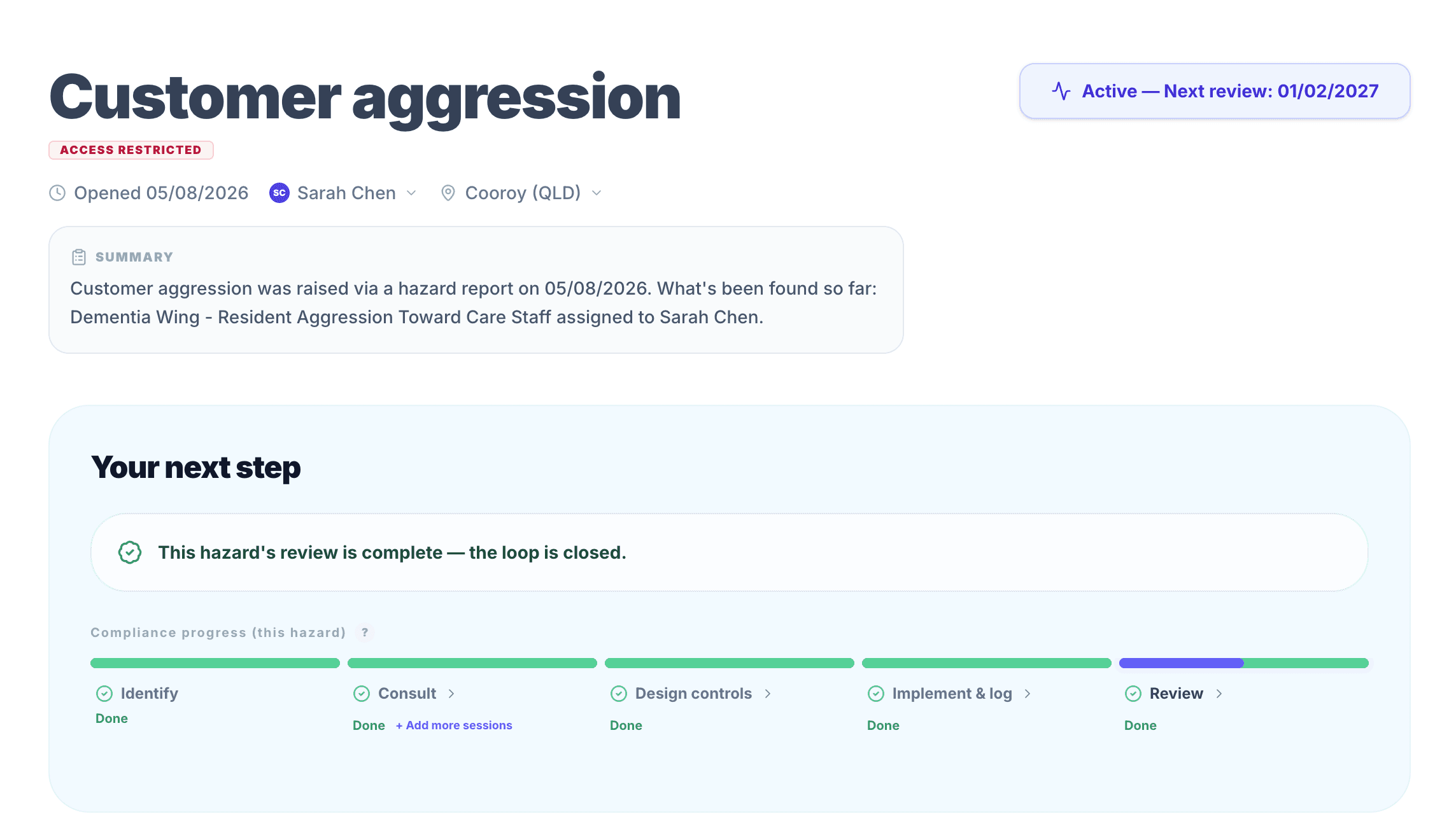
Whichever hazard the record starts from, this is what it looks like once it has been tracked through to a closed loop:
What this looks like when it's running
Doing this by hand works until it doesn't. Across every hazard, every worker, and every review date, the record gets hard to hold in your head. That is what PsychProof runs. It takes the same four steps, identify, consult, control, review, and keeps them as one time-stamped trail per hazard: the evidence regulators and insurers ask for when something goes wrong. Here is one hazard tracked end to end.
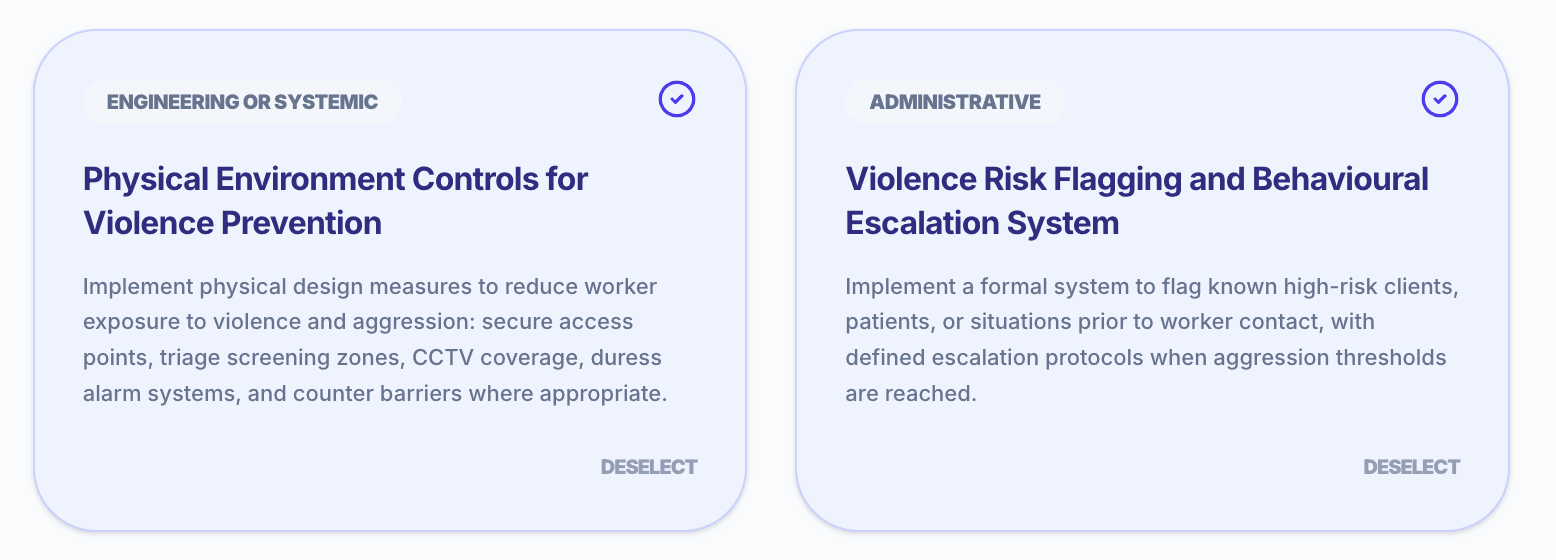
Controls aren't just chosen. They're categorised against the hierarchy, engineering and systemic before administrative, and the categorisation is part of the record.
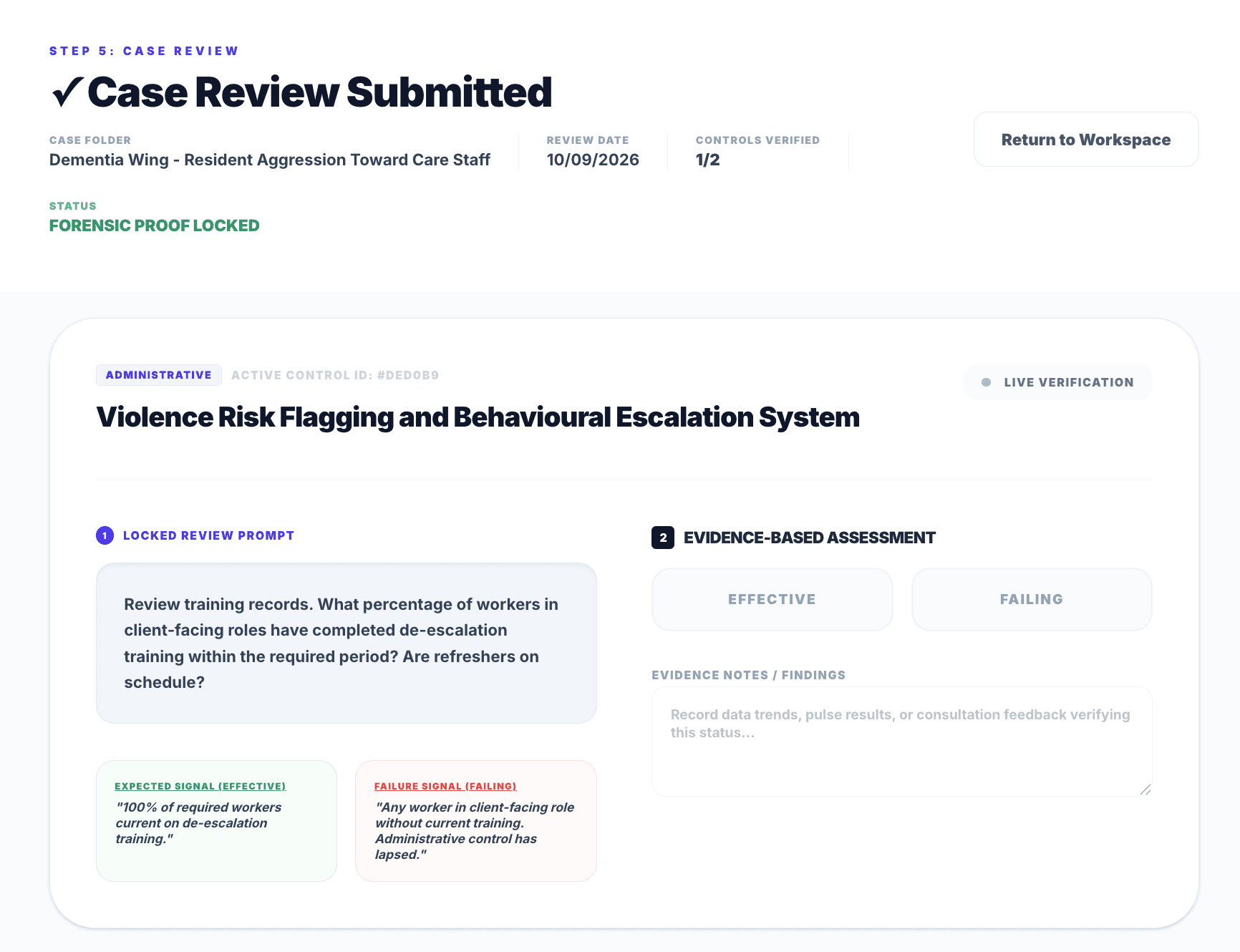
And review is evidence-based: each control is checked against an expected signal and a failure signal, then locked.
See what running this looks like
The six hazards above each need identification, a first control, and a record. PsychProof runs that loop for every hazard and closes it with a dated review.
What to read next
The patterns most aged care operators miss
Once you have identified the common hazards, this article covers the interactions between them that most risk assessments underweight and why they matter.
What ongoing psychosocial management looks like in practice
A worked example of how a facility manager used routine check-ins and documented conversations to build a compliance record over time.
Important Notice
This information is general in nature and provided for awareness and documentation support only. It does not constitute legal, clinical, or professional advice. Regulatory obligations vary by jurisdiction and circumstances. Organisations should refer to relevant regulators or qualified professionals for advice specific to their situation.