
Change Planner
Change may create psychosocial risk.
Under Victoria's OHS (Psychological Health) Regulations 2025, employers must review, and if necessary revise, their psychosocial risk controls before a change that is likely to change those risks. Plan it in about ten minutes.
How it works
Four steps, about ten minutes.
Free. No account. No subscription.
Pick the change
Choose from ten everyday changes: a new roster, a new manager, new targets, a hybrid policy, a hiring freeze and more.
Describe it
When it lands, how many people it affects, and a couple of sentences on what is changing. That is all it needs.
Review your plan
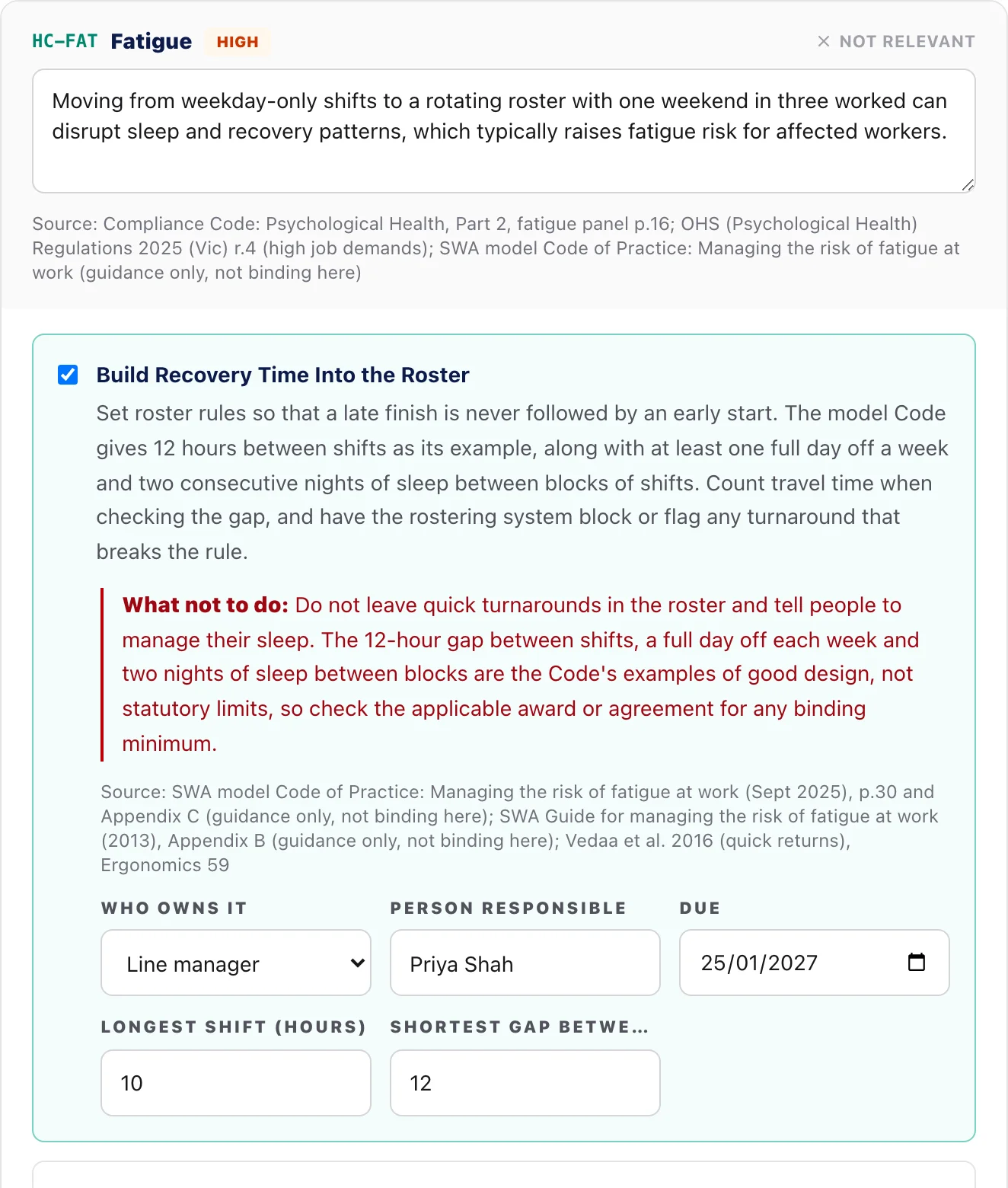
See the psychosocial hazards this change brings, with controls from WorkSafe's Compliance Code, who owns each one and when it is due. Change anything.
Check it and keep it
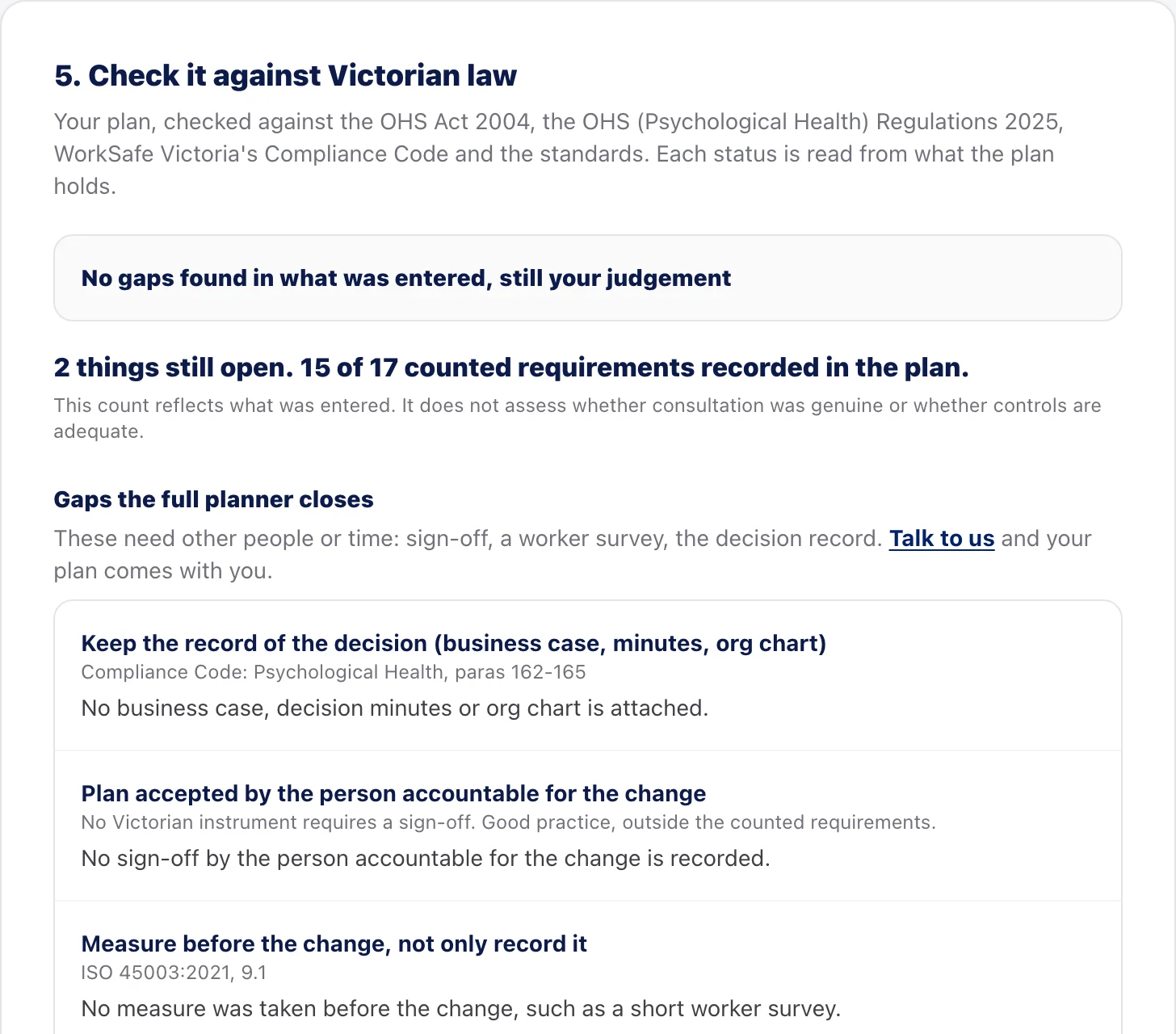
See how the plan stands against the OHS Act, the OHS (Psychological Health) Regulations 2025 and WorkSafe's Compliance Code. We check it and email it to you as a PDF within one business day.
What you get
A short, dated plan with the hazards, the controls and who owns each one, your consultation record, a check against Victoria's OHS Act, the OHS (Psychological Health) Regulations 2025 and WorkSafe's Compliance Code, and a review date. Checked by us, then emailed to you as a PDF within one business day. Material change? See a sample full assessment.
Why plan it
See it coming. Know who is handling it.
The hazards, before the first complaint
A new roster, a new manager or new targets changes workload, control and support. You see which hazards that kind of change typically brings while you can still do something about them.
Controls you can act on
Each hazard comes with controls drawn from WorkSafe's Compliance Code and published guidance, the source named beside it, and a line on what not to do.
An owner for every step
Every control gets an owner and a due date, and the plan sets a review about 90 days after the change lands. Nothing is left as a good intention.
A plan you can put on the table
A short, dated plan that shows what you saw coming and what you did about it. Something to present to the board, your manager or an inspector who asks.
Who we are
Built in Australia. Tested by the people who check this work.
PsychProof is an Australian psychosocial risk platform. Change Planner is the part of it that plans a change before it lands.
Tested by the people who check this work
Former WHS inspectors and regulators, a former Fair Work Commission conciliator, WHS lawyers and psychosocial risk consultants. We asked them where it would fail, and changed it.
Built to the standards you are held to
Built to ISO 45003 and the Safe Work Australia model Code of Practice, with your state's own instruments named in every plan.
Australian built, Australian data
Built in Australia for Australian WHS law. Your records are stored in Australia.

Finalist
Innovation in Psychosocial Risk Management
Psychosocial Safety and Leadership Awards 2026
“The platform was built to eliminate the gap between hazard identification and action.”
Inside the product
See the core steps.
Define the change, impacted groups, people risks, the change plan, and the plan across prepare, manage and sustain. AI and digital changes also get a digital work system profile and the code check.

Define the change

Impacted groups

People risks

Change plan

Prepare, manage, sustain

Plan and evidence
A fair question
Why not just ask a chatbot?
You can. Type “we are restructuring, plan the psychosocial risks” into any AI chatbot and you will get a reasonable first draft. Here is what that leaves you to do yourself.
| What you need | A chatbot prompt | Change Planner |
|---|---|---|
| A first draft of hazards and controls | Yes, in seconds. It is a reasonable place to start. | Yes, and the controls come from a fixed library. Each one carries its source and a note on what not to do, so nothing is made up on the spot. |
| An answer you can defend | A different plan each time you ask. Nothing guarantees the same instrument or clause comes back. | The Victorian instruments are applied by rule, and the check against them has no AI in it. The same plan always gets the same result, with the provision cited. |
| A record that workers and HSRs were consulted | Nothing. It cannot ask them. | A consultation survey goes to the affected workers. The plan records when consultation happened, whether that was before the decision, and whether an HSR or worker representative took part. |
| Other people in the plan | None. It is a document only you have seen. | The change lead signs off and each control owner answers, by email, without a login (sign-off is good practice, not required by Victorian law). |
| What happens after the change lands | Nothing, unless you remember to go back. | Reviews are scheduled at 90 days, and at 6 and 12 months for a material change. Owners report whether each control worked. |
| Proof of when it was done | A chat history. It shows when you asked, not when anything was agreed. | A dated plan showing who signed it and when, sealed with an RFC 3161 timestamp from an independent timestamping authority. |
Need a draft? Use a chatbot. If the plan has to be agreed, carried out and checked afterwards, that is what Change Planner is for.
Timestamps are issued under RFC 3161 by FreeTSA, a timestamping authority that is independent of PsychProof.
How PsychProof handles change management
Built from the evidence, not a framework.
Plan a Change follows the same five steps as every hazard in PsychProof: identify, consult, design controls, implement, review. It is built from longitudinal cohorts, systematic reviews and meta-analyses, not from a practitioner change model.
Change hurts, measurably, and the effect lasts longer than a 90-day review
- A German employment survey of 53,295 employees, tracked from 2006 to 2018, found those who had been through change in the last two years were 1.82 times as likely to report poor mental health. The gap did not shrink across the twelve years of the study.
- A Norwegian cohort covering five change types found employees who went through repeated changes in a two-year window fared substantially worse on every psychosocial measure than a single change did.
- A Finnish cohort of 22,430 municipal employees followed for 7.5 years found major downsizing predicted higher sickness absence and roughly double the cardiovascular mortality among the people who kept their jobs.
A single review at 90 days measures the acute phase and misses the tail. Change Planner now asks how much change a cohort has already been through, and schedules follow-up reviews past the first 90 days for material changes.
Communication and participation solve different problems
A field study of workers facing organisational change found three kinds of uncertainty: strategic, structural and job-related. Communication reduced the first. Only participation in decision-making reduced the other two. Change Planner no longer treats them as interchangeable.
A realistic preview works
In a longitudinal field experiment after a merger, the plant given a realistic preview (what changes, what does not, the timeline, the criteria, the support) returned to pre-announcement trust. The plant that got the standard announcement never did.
Procedural fairness outweighs the outcome itself
A meta-analysis of 37 samples found procedural justice predicted how survivors of a downsizing responded more strongly than what they actually received. Change Planner records the decision rule and the account given to workers, not just the outcome.
The rollout itself is where most support is needed
A study of technology go-lives found units with more engaged peer helpers gained significantly more proficiency in the first six weeks. Adoption data from a major AI rollout showed a predictable dip in uptake between roughly week three and week ten. Change Planner's during-phase controls now cover both.
New in this release
AI rollouts and digital systems now get their own check.
The NSW Digital Work Systems Act does not apply in Victoria.
AI or a new system? Four questions, not a new process.
If the change introduces or alters a system that allocates, monitors, scores, or decides about work, we ask what it does and whether it can create unreasonable workload, excessive metrics, surveillance, or unfair decisions - the kind of record the Safe Work Australia AI guidance and the AI Safety Standard point to (guidance only in Victoria).
See the gaps before an inspector does.
Your plan is checked against the Code of Practice, your state's regulation, ISO 45003, and, for AI and digital systems, the guidance and duties above. Every row cites its source and shows covered, weak, out of order, or missing.
How much change has this team already absorbed?
Repeated change compounds. A cohort that's been through two or more significant changes in the last 24 months now raises the confidence of the demand and change-management hazards flagged, instead of every change being scored as if it were the first.
The preview and the decision rule, on the record.
For a redundancy, restructure, merger or AI rollout, the plan now checks for a realistic preview (what changes, what doesn't, the timeline, the criteria, the support) and, where it applies, the decision rule and the account given to workers - not just that a communication happened.
A gap, shown
A weekend roster, checked against Victoria's rules.
A 14-person warehouse team moves to a rotating weekend roster. Here is what the quick plan found.
15 of 17 counted requirements recorded in the plan. The two still open are named, with what would close them.
| Requirement | Source | Status |
|---|---|---|
| Consult affected workers before the decision | OHS Act s.35 | Recorded |
| Involve the HSR as required | OHS Act s.35(4), Regulations r.9 | Recorded |
| A control that alters the work, not training alone | Regulations r.15 | Recorded |
| Existing controls reviewed before the change | Regulations r.16(1)(a) | Recorded |
| Keep the record of the decision | Compliance Code paras 162-165 | Missing |
| Measure before the change | ISO 45003, 9.1 (guidance) | Missing |
Example plan for a fictional organisation. Requirements sourced from Victorian legislation and WorkSafe's Compliance Code.
We know you're already doing a lot.
What you already have
You already have HR platforms, engagement surveys, and incident management systems.
- Engagement platforms tell you how people feel right now.
- Incident systems capture what went wrong after the fact.
What's missing
A documented process. Hazards identified before the change. Action plans with owners and deadlines, and a record you can hand to the board or an inspector. Timestamped before anything went wrong.
This is the compliance gap.
How the AI earns trust
The AI shows its work.
Unlike a generic chatbot, every hazard and control PsychProof identifies cites where it came from: the Safe Work Australia Code of Practice, ISO 45003:2021, or the specific section of the WHS Act. Nothing is asserted without a source you can check yourself.
- 17
- Hazards mapped
- 81
- Cited controls
- 3
- Evidence tiers
- 38
- Requirements checked
Poor Change Management
A significant change to work practices, roles and responsibilities without a managed process creates foreseeable psychosocial risk.
Every hazard card in your report looks like this: traceable, not asserted.
Want the legal background? See what the law now says about workplace change
We can't prove your past decisions. We can seal the future ones.
Can't our WHS consultant just do this?
They can, and for a major change you should have one. Change Planner does the mapping and the coverage check in an afternoon, so your consultant's time goes on the interviews, the root causes and the implementation, not the paperwork. PsychProof works with a network of independent WHS consultants who use the platform with their clients.
Is this an ISO 45003 certification?
No. It measures your change plan against the clauses that apply to change and shows the gaps with sources. Certification is an external audit. This gives you the evidence an auditor asks for.
Does this replace our HR system?
No. This sits alongside it. HR systems manage the employee lifecycle. Change Planner creates a timestamped record that you assessed and planned for psychosocial risk during an operational change.
How accurate is the AI? Could it get something wrong?
The coverage table isn't AI. It's a set of rules over what you recorded. Only the recommendation text is written by AI, and every hazard, control and requirement cites its source (the Code of Practice, ISO 45003:2021, or a WHS Act section) with an evidence tier, so you can see exactly how strong the basis is. It's a structured starting point for your review and consultation, not a replacement for your judgement or your workers' input.
What does it cost?
You see the result before you pay anything. A quick plan is free. A full assessment is priced to the size of the change, after a short call. PsychProof Compliance at $599 a month covers every change and the register behind it.
What if we have a second change?
Another quick plan is free. A full assessment is priced for each change after a short call, or move to Compliance at $599 a month, which covers every change plus the register and reviews behind them.
Is our data kept private?
Your plans and records are stored in Australia (Sydney). The reasons in a quick plan are drafted by AI: names and contact details are removed first, and the text is processed by Anthropic, which may be outside Australia. Timestamping sends only a fingerprint (hash) of the record, never its content. Full detail on encryption, access controls, and our security posture is on our Trust page.
We've already had an incident related to this kind of change. Does this still help?
Yes. A documented assessment does not undo what has happened, but it gives you a record of genuine effort from here. You do not need to wait for a near-miss: a record made before the change is worth more than one assembled afterwards.
Rolling out AI or restructuring this quarter?
Send us the outline and we'll return the coverage table for it: the gaps against the Code, ISO 45003 and the digital work system duties, sourced.
Quick plan free. Full assessment priced to the change, after a short call.