

Managing Psychosocial Hazards in New South Wales: Compliance Guide
In New South Wales, psychosocial hazard obligations are governed by the Work Health and Safety Act 2011 (NSW) and the Work Health and Safety Regulation 2025, which replaced the 2017 Regulation and explicitly requires PCBUs to apply the hierarchy of controls to psychosocial risks. From 1 July 2026, section 26A of the WHS Act made compliance with the Managing Psychosocial Hazards at Work Code of Practice a standalone enforceable duty, not just persuasive guidance, so a documented gap against the Code can now trigger an improvement notice, a prohibition notice, or prosecution on its own. Inspectors now expect demonstrable, documented risk management systems, not just policies.
Legislative framework
Digital work systems and monitoring technology
A new section 21A of the WHS Act creates specific employer duties around digital work systems, covering monitoring technology used on workers and requiring employers to manage union representative access when investigating suspected breaches. Organisations using productivity trackers, keystroke monitoring, or similar systems should treat this as a live psychosocial hazard to manage, not just a privacy question to file away.
How this differs from other jurisdictions
NSW explicitly mandates the hierarchy of controls for psychosocial risks under its 2025 Regulation, aligning it with QLD and the Commonwealth. It now goes further than most other jurisdictions too: since 1 July 2026, NSW is the only state where compliance with the psychosocial Code of Practice is itself a standalone enforceable duty under section 26A, rather than persuasive evidence of meeting a broader duty. See our Australian comparison page for context.
Sector-Specific Guidance for New South Wales
Psychosocial risk exposure varies significantly by sector. If you operate in one of New South Wales's higher-risk industries, these resources apply the same regulatory framework to your specific operating context:
Check Your Compliance
A short set of questions on how hazards get identified, documented and reviewed today, scored against the NSW Code, with a gap analysis you can act on.
Where PsychProof sits in an NSW employer's toolkit
Survey tools stop at identification. Incident systems start after harm. PsychProof owns the step in between, and in NSW, that step is no longer optional evidence: it is the standalone duty under section 26A.
A PAW or COPSOQ survey tells you where the hazards are. A workers' compensation claim or incident report tells you harm has already occurred. Since 1 July 2026, SafeWork NSW can issue a notice for a documented gap against the Code of Practice on its own, meaning the connective evidence between identification and harm is no longer just best practice: it is the thing being directly enforced on.
That is the gap most NSW employers have. Not a lack of survey data, and not a lack of an EAP provider, but a lack of the ongoing, dated record showing hazards were identified, controls were designed against the hierarchy, workers were consulted, and effectiveness was reviewed. PsychProof is built specifically for that step.
What inspectors look for in New South Wales
SafeWork NSW has shifted from education to compliance. Inspectors expect to see evidence of active risk management, looking closely at how investigations and internal issues (like 'poor organisational justice') are handled. Since the Code of Practice became independently enforceable in July 2026, a documented gap against the Code is now grounds for a notice on its own, separate from proving a breach of the underlying WHS duty.
How PsychProof maps to New South Wales obligations
PsychProof cites the Work Health and Safety Regulation 2025 (NSW) and reflects the Code of Practice's enforceable status. It provides SafeWork NSW inspectors with clear, time-stamped evidence of how risks, including digital monitoring hazards, are managed using the hierarchy of controls.
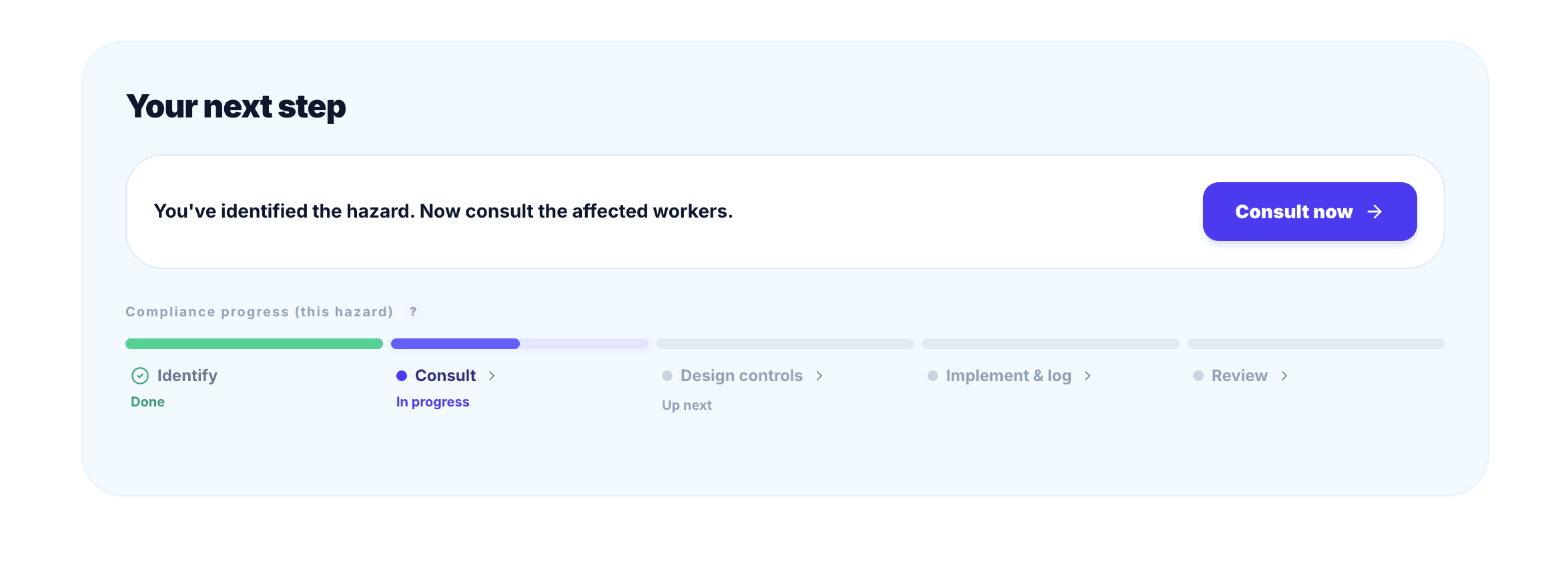
See what running this looks like for an NSW employer
PsychProof runs the four-step cycle for every hazard and closes it with a dated review, the evidence trail SafeWork NSW now enforces directly under section 26A.
What to read next
What does "psychosocial" actually mean?
The plain-English definition behind the Act and Code language on this page, and why the distinction from mental health and HR matters operationally.
A worked risk assessment example
See the identify-assess-control-review cycle applied to a real hazard, from first identification through to a closed, reviewed control.
Important Notice
This information is general in nature and provided for awareness and documentation support only. It does not constitute legal, clinical, or professional advice. Regulatory obligations vary by jurisdiction and circumstances. Organisations should refer to relevant regulators or qualified professionals for advice specific to their situation.