

Not a survey. Not a dashboard.
Survey tools stop at identification. Incident systems start after harm.
PsychProof owns the step in between, the one regulators actually enforce on, and proves it. A survey flag, a manager's note, an anonymous report, every signal from every source, brought under control and kept there as the workplace changes.
The proactive approach
We can't prove your past decisions. We can seal the future ones.
Your next change is already on the horizon. A restructure. An AI rollout. A leadership transition. Whatever it is, use PsychProof for this one.
We'll take you through it step by step: identifying the specific psychosocial hazards your change introduces, guiding you through the controls that address them, and building the documented record that proves you acted before anything went wrong.
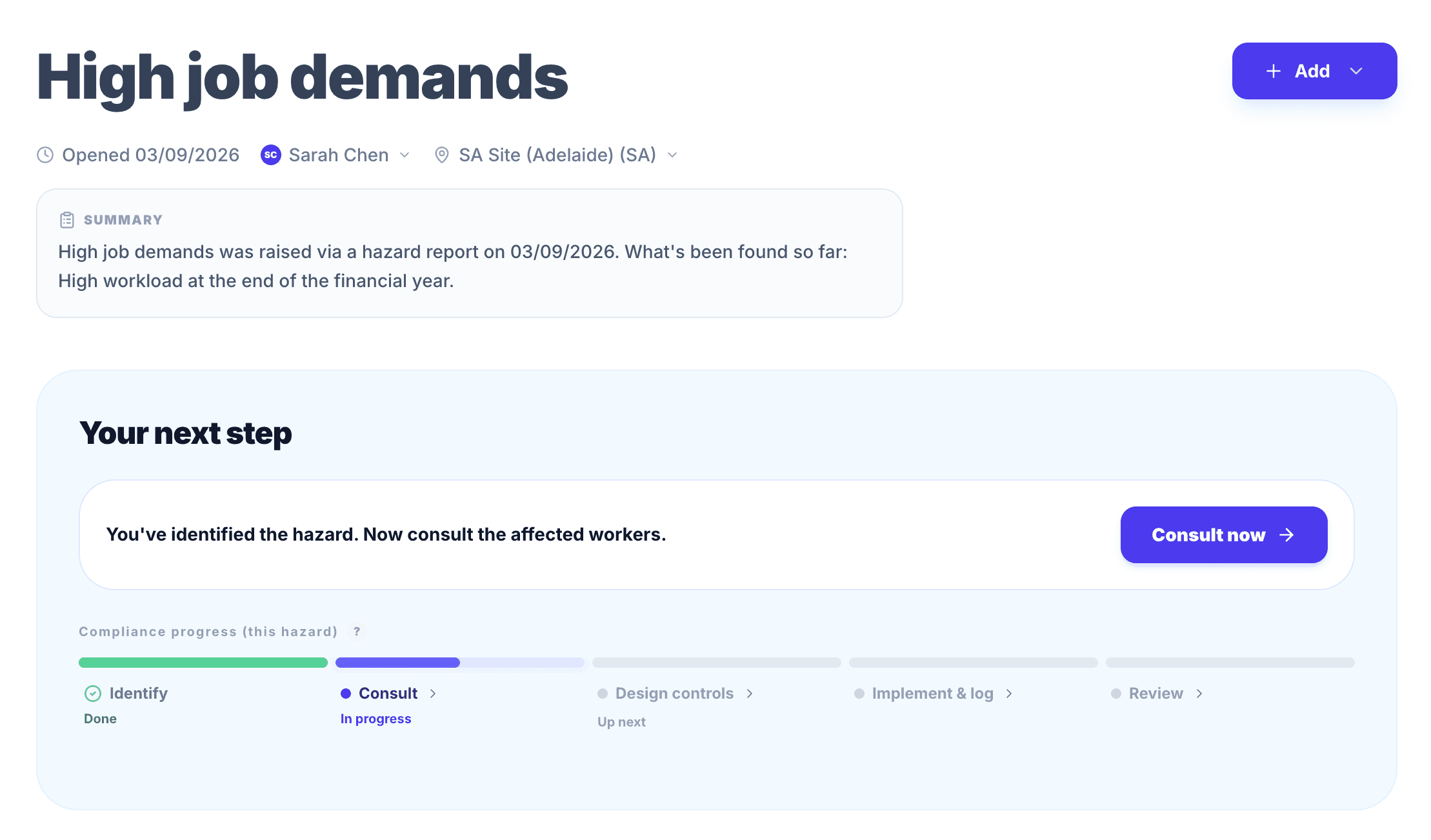
You don't need to be a WHS expert. The engine knows what to look for. You just need to tell it what's changing.
PsychProof runs your everyday hazards the same way. The Change Planner is just the sharpest place to start, because a planned change is a hazard you can get ahead of.

Change Architecture

Cohort Definition

Hazard Mapping

Control Library

Mitigation Plan

Evidence Workspace
A concern, a case, a risk assessment, a planned change. One place.
Every piece of the puzzle, one platform
Every piece, one platform
Hover a segment to see what it does, or click to jump straight in. A hazard report, a case, a risk assessment, and a change plan, all resolving into the same record.
An illustrative scenario
From roster change to a closed notice.
A mid-size Australian mining operator announced a significant roster change across two remote sites. Before the announcement went out, HSEQ ran a Change Planner assessment. Here is what happened next.
Day 1: the change event
Roster change assessed before announcement
HSEQ runs a Change Planner assessment before the roster change is communicated to crews. The tool maps the roster change to fatigue and sleep disturbance hazards under the Code of Practice, producing a timestamped report with recommended controls. A targeted check-in trigger is scheduled for the affected Drill & Blast crew.
The evidence trail starts here, before anyone has complained about anything.
Day 14: signal captured
Critical fatigue signal flagged
A Drill & Blast supervisor logs an observation via Teams check-in: "Two blokes told me separately they're not sleeping well. New roster rotation means some guys are doing longer drives at the end of a swing." The signal is auto-escalated to HSEQ. A manual follow-up is flagged as required.
Day 90: inspection
Improvement notice closed
During a follow-up inspection triggered by a separate incident, HSEQ presents the PsychProof registry. The Change Planner assessment, run before the roster change was announced, is the first document produced. It demonstrates the organisation identified the fatigue hazard before any harm occurred. 126 timestamped monitoring responses and documented control actions close the loop. The improvement notice is closed.
The record existed before the complaint. That is the difference between closing a notice and defending a prosecution.
Questions we often hear
"Can't our WHS consultant just do this?"
A consultant produces a report. PsychProof produces a timestamped, hashed record. The difference matters when a safety inspector asks not just what was recommended, but when the assessment was conducted, and whether it existed before the incident was reported. A Word document with today's date cannot answer that question. A timestamp can.
"Our lawyers handle this."
Your lawyers need evidence to work with. PsychProof creates the primary record: the documented proof that hazards were identified and controlled before the incident occurred. Your lawyers interpret it. Without it, they have far less to work with.
"Our HR team manages psychosocial risk."
HR manages the employment relationship. Psychosocial risk records are legal evidence, and inspectors expect them to be produced independently of the managers who may be the subject of a complaint. Separation is a regulatory expectation, not an overhead.