



How we're different
Survey tools stop at identification. Incident systems start after harm.
PsychProof owns the step in between, the one regulators actually enforce on, and proves it. We research the hazard, suggest the controls, help you put them in place, then keep reviewing them, and every move is time-stamped so the record exists before anyone asks for it.

The gap
A finding you ignore is worse than one you missed.
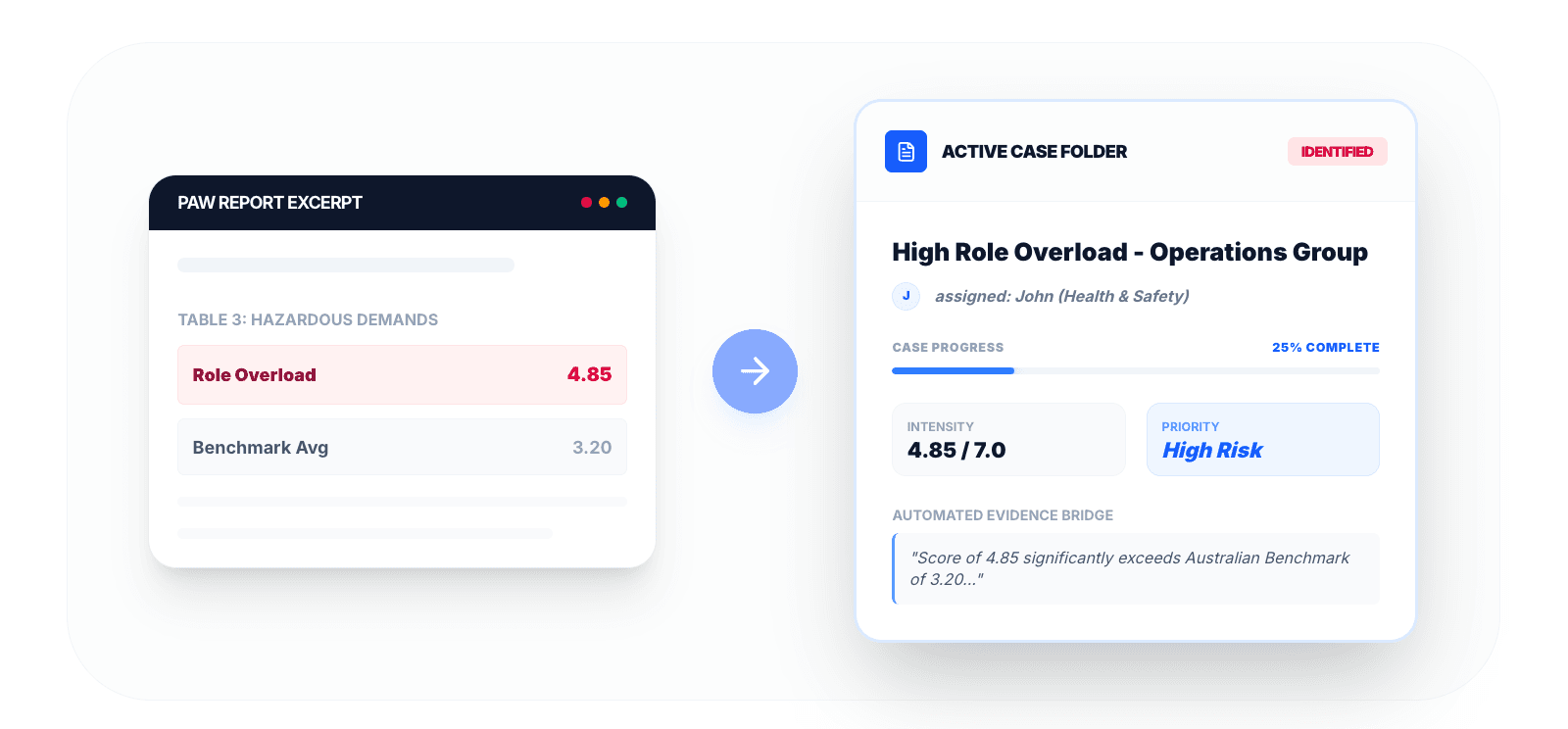
Assessment and reporting tools are good at their job. They find the risk and they log the incident. Then they stop, and the hazard is still sitting there.
When a regulator or a lawyer asks what you did between the score and today, a dashboard has no answer. That space in between is where harm happens. It's the space we work in.
The exposure isn't abstract. A serious psychological injury claim now runs to a median of $67,400 in compensation, more than four times the median for all other serious claims, and these claims have risen 161% in a decade, the fastest growth of any injury category.
Source: Safe Work Australia, Key Work Health and Safety Statistics Australia 2025 (2023-24 data).
And the step regulators check is not the survey. A former WorkSafe WA inspector told us that of the improvement notices he wrote in his record year, easily 70% were for one clause: failure to review control measures. Not missed hazards. The step after.
Where most tools end
- A survey score
- A dashboard
- An incident log
Where PsychProof begins
- Suggesting evidence-based controls
- Putting the action in place, with consultation
- Reviewing whether it actually worked
- A record that proves all of it
A finding, the moment it stops being a number on a page
The ongoing part
We turn one survey into an ongoing process.
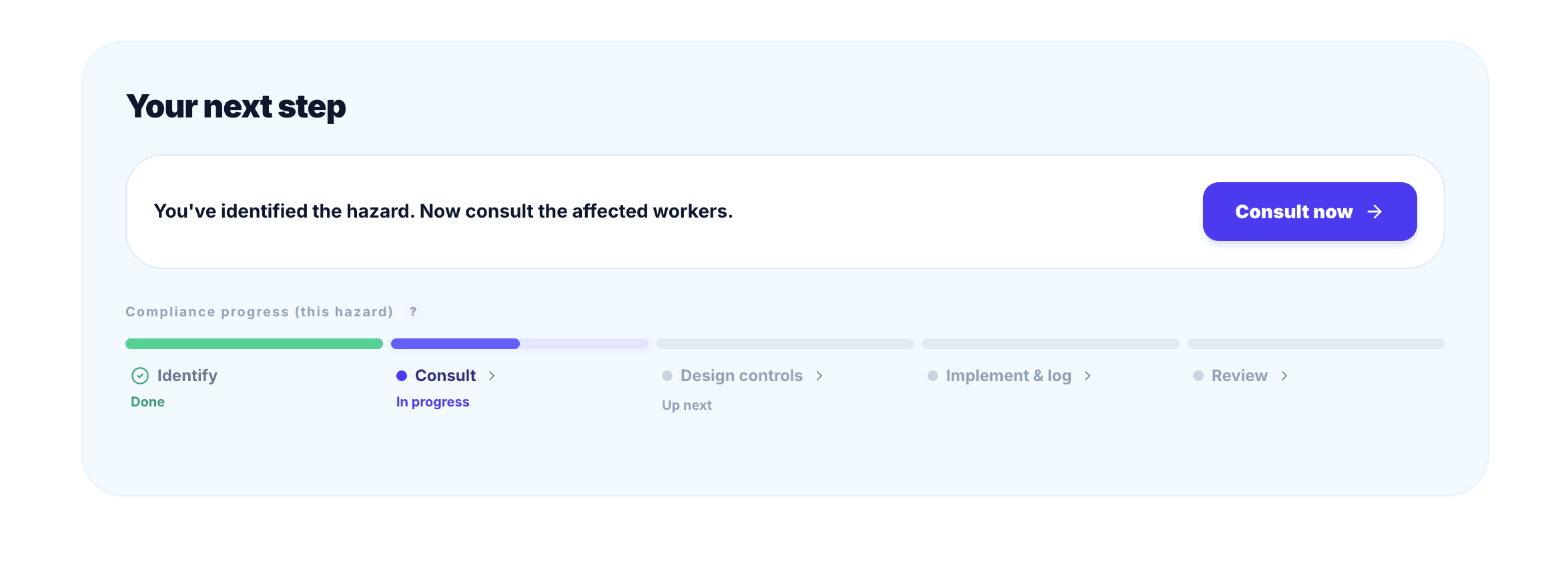
Psychosocial risk isn't a project with an end date. Teams change, conditions change, and a control that worked last quarter can quietly stop working. So we built a loop, not a checklist.
Research the hazard
We look at what the signal actually means for your workplace and what the codes of practice expect of you.
Suggest the controls
You get specific, evidence-based controls to choose from, ranked by the hierarchy of controls, not a blank text box.
Put it in place
Assign it, consult the people affected, and record what was agreed and by whom.
Review whether it worked
Set a review date, check the control is still holding, and score its effectiveness honestly.
Keep going
If the risk is still live, the loop starts again. Nothing gets left half done.
Proactive, not reactive
Before a big change hurts people, we plan for it.
Restructures, redundancies, mergers and new rosters are some of the most predictable causes of psychosocial harm, and they're almost always known about well in advance.
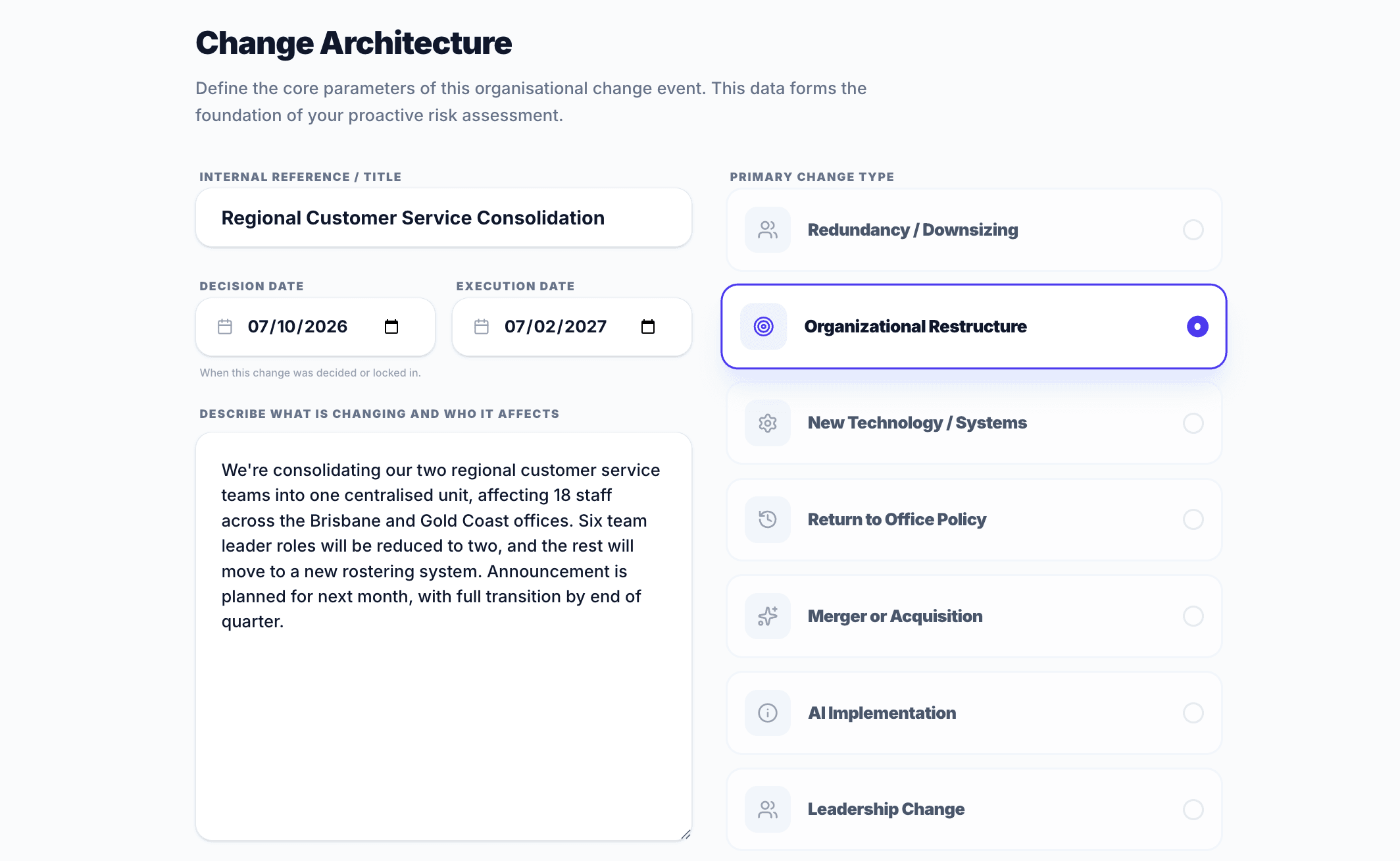
PsychProof lets you plan a substantial change before it lands, so you get to prevent the harm instead of documenting it afterwards.
- 01Name the change and who it will affect
- 02Consult early, before decisions are locked
- 03Put controls in place ahead of the impact
- 04Keep the plan and the reasoning on the record
The usual way
Change happens, people struggle, the paperwork gets written after the complaint.
The PsychProof way
The change is mapped, consulted and controlled before it lands, and the plan is already on the record.
The byproduct
Do the work properly, and the proof writes itself.
Every step above is time-stamped and consultation-logged as you go. So when an auditor, a regulator, or a lawyer asks what you did, when, and who you spoke to, the answer already exists.
Other tools can show you the risk and help you plan. What they can't give you is proof. Every step here is timestamped and consultation-logged as it happens, and the record is tamper-evident, so it can't be edited or back-dated later. When someone asks what you actually did, you're not reconstructing it. It already exists.
Questions we get asked
We already run a survey tool like FlourishDx or Mibo. Does PsychProof replace it?
No. PsychProof starts where those tools stop. Keep your survey, it tells you where the risk is. PsychProof takes each finding through control, consultation and review, and keeps the tamper-evident record that proves it was done. They sit together, they don't compete.
Is the record actually defensible?
Every step is timestamped and consultation-logged as it happens, and the record is tamper-evident, so it can't be back-dated or edited after the fact. It's built to hold up when a regulator or a court asks what you did, when, and who you consulted.
Where is our data stored?
In Australia. All customer data is stored and processed in Sydney (AWS ap-southeast-2), with no offshore processing of your records.
Do we need consultants to use it?
No, the guided flow walks you through it. If you want expert help, we work with WHS consultants who can implement it alongside you.