


Psychosocial Hazards in Manufacturing: WHS Obligations and Where to Start
Serious workers' compensation claims for mental health conditions have risen 14.7% in a year and 161% in a decade nationally, and manufacturing carries its own distinct profile: shift work, production-line pace, high-noise environments and isolated, repetitive roles. The WHS obligation to manage psychosocial hazards applies to every plant, regardless of size. This page covers what you are required to do, the hazards most relevant to manufacturing, and what a realistic first response looks like.
What the law requires
Under the model Work Health and Safety Act, manufacturers (as PCBUs) must identify psychosocial hazards, assess the risk, implement controls, and review their effectiveness. The Safe Work Australia model Code of Practice on Managing Psychosocial Hazards at Work provides the operational framework, and it applies to production, maintenance, warehousing and support roles alike, not only office staff.
What regulators look for is evidence that the process occurred: records of hazard identification, consultation with workers on the floor, control decisions, and review. A safety induction slide on "wellbeing" is not evidence of that process.
The 6 most common hazards in manufacturing
Here are the six hazards most relevant to manufacturing, each with a realistic first control and what to record. You do not need all six solved to be compliant. You need evidence that you are working through them.
Rigid production-line pace and demand-resourcing mismatch
A line speed or quota set without matching resourcing or recovery time is a structural psychosocial hazard, distinct from an individual worker's performance. A first control is a documented process for reviewing line speed against actual staffing and skill mix when either changes. Record: when the review last occurred, what was assessed, and what, if anything, changed as a result.
Shift work and rotating rosters
Rotating shifts, particularly night shifts on a production floor, reduce recovery time and peer support in ways that accumulate over months, not just after one bad night. A first control is a documented fatigue management approach specific to the roster pattern in use. Record: what pattern is in place, when it was last reviewed, and any fatigue-related incidents logged against it.
High-noise and low-communication environments
Environments where hearing protection or ambient noise make normal conversation impossible isolate workers from informal support and make early warning signs harder for supervisors to pick up. A first control is scheduled, structured check-ins that do not rely on incidental conversation on the floor. Record: the check-in schedule, who conducts it, and what was raised.
Repetitive, low-variety tasks
Highly repetitive roles with little task variety are a named hazard (low job variety) under the SWA Code, and are associated with disengagement and reduced job satisfaction over time, not just physical strain. A first control is a documented job rotation or task variation plan for roles identified as high-repetition. Record: which roles are covered, the rotation schedule, and whether workers were consulted on it.
Job insecurity from restructuring and automation
Plant restructures, offshoring pressure, and the introduction of automation or robotics generate job insecurity anxiety whether or not headcount actually changes, and workers frequently read automation as a precursor to redundancy regardless of intent. A first control is clear, early communication of what a change will and will not affect. Record: that the communication occurred, what was said, and what questions were raised and answered.
Poor organisational change management
New equipment, process changes and quality system overhauls are recurring sources of psychosocial risk when rolled out without adequate consultation or training time. A first control is a documented change communication for any significant process or technology change, delivered before it lands on the floor. Record: that the communication occurred, when, and via what channel.
Check Your Compliance
A short set of questions on how hazards get identified, documented and reviewed today, scored against your state's Code, with a gap analysis you can act on.
The simplest form of compliance is a documented conversation
A line supervisor who notices an operator seems disengaged or is making uncharacteristic errors does not need a platform, a survey, or a formal incident report to begin a compliant response. They need to have a conversation and write it down.
What that looks like in practice:
That is a psychosocial consultation. It identifies a hazard, surfaces worker input, and documents a control action. It does not require a formal process to begin. It requires a habit of writing it down.
As that habit grows, covering more workers, more issues, and more consistent records, the organisation builds the evidentiary record that regulators and insurers ask for when something goes wrong.
Whichever hazard the record starts from, this is what it looks like once it has been tracked through to a closed loop:
What this looks like when it's running
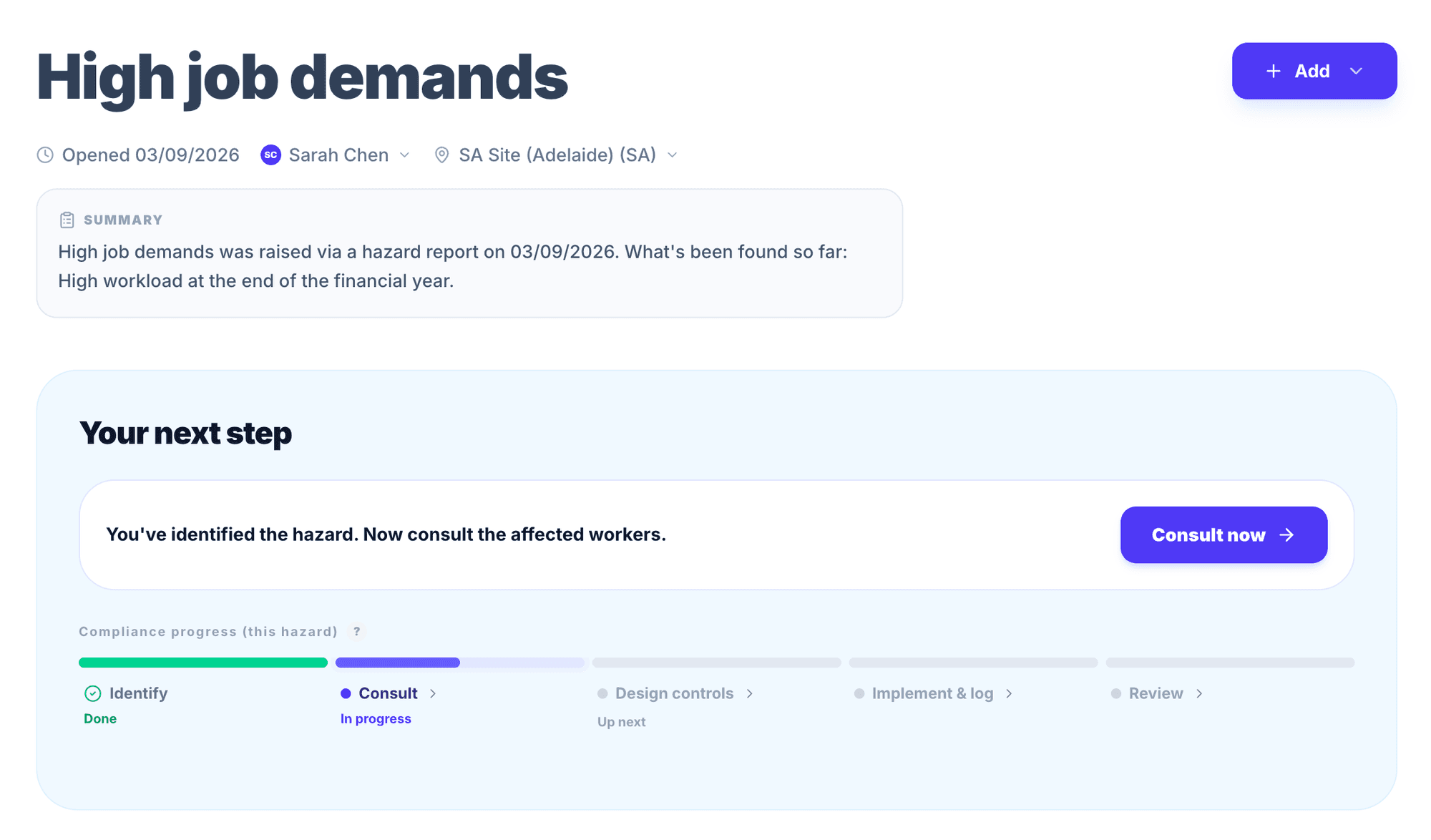
Doing this by hand works until it doesn't. Across every hazard, every worker, and every review date, the record gets hard to hold in your head. That is what PsychProof runs. It takes the same four steps, identify, consult, control, review, and keeps them as one time-stamped trail per hazard: the evidence regulators and insurers ask for when something goes wrong. Here is one hazard tracked end to end.
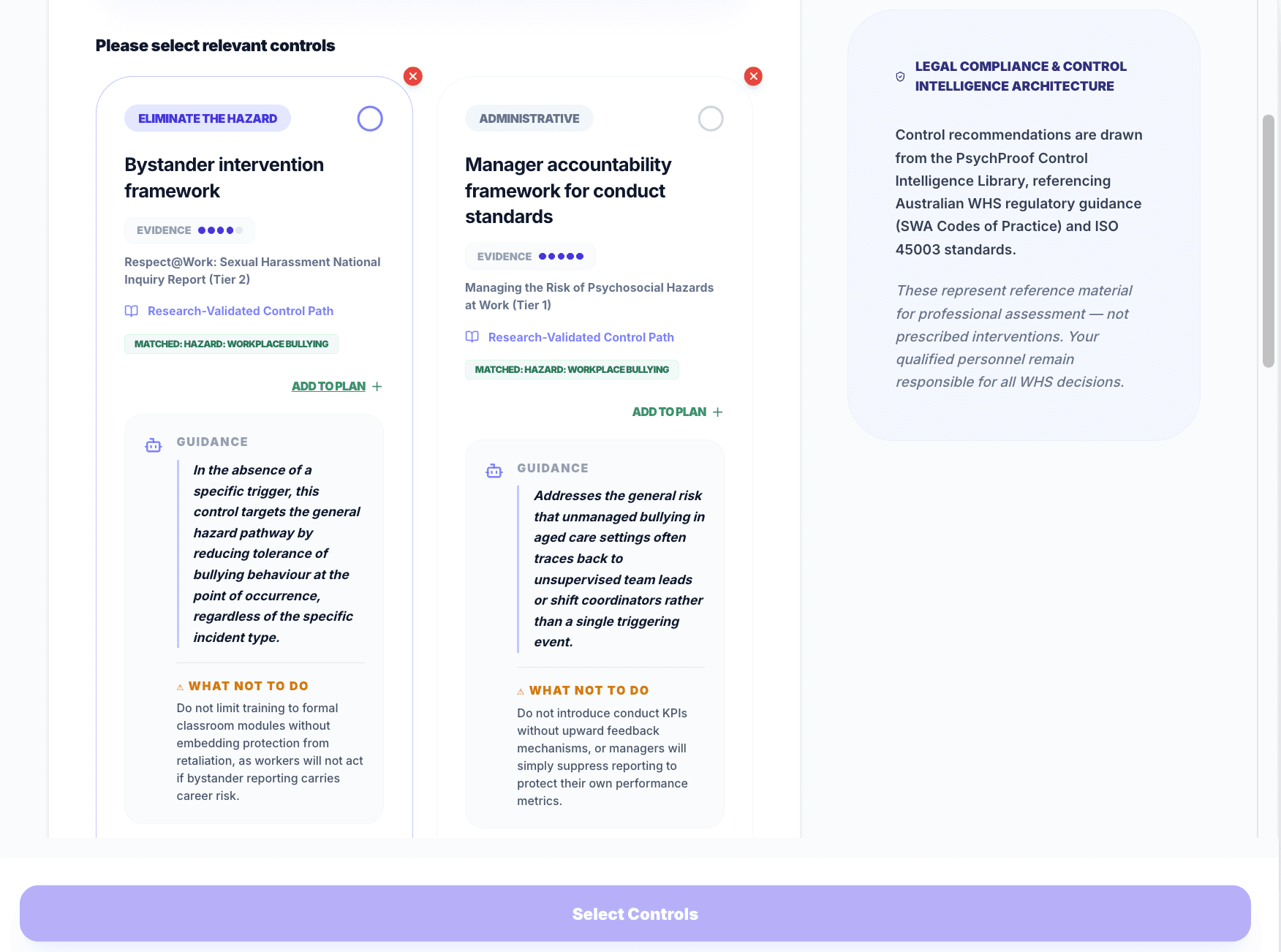
Controls aren't just chosen. They're categorised against the hierarchy, engineering and systemic before administrative, and the categorisation is part of the record.
Try our pilot programme
Pick a department, a unit, or a small team. We run PsychProof there on real hazards for six months, so you can see if it's for you, with nothing committed beyond that one team.
What to read next
Planning a restructure, AI rollout, or new system?
Change is a named psychosocial hazard in its own right. See how PsychProof assesses a change before it happens, not just the hazards it leaves behind.
Get the printable PsychProof overview
A working note on where PsychProof fits, what it does and does not do, and how the methodology adapts to your sector. Print it or send it internally.
Important Notice
This information is general in nature and provided for awareness and documentation support only. It does not constitute legal, clinical, or professional advice. Regulatory obligations vary by jurisdiction and circumstances. Organisations should refer to relevant regulators or qualified professionals for advice specific to their situation.